Bangladesh has concluded its national voting for the first time since the protests, inspired by Gen Z, successfully ousted long-time Prime Minister Sheikh Hasina in 2024. In this election, more than 2,000 candidates are contending for 300 parliamentary seats, notably without any from the banned Awami League, which ruled for 15 years and faced accusations of severe repression against protesters.
The political contest this time sees the Bangladesh Nationalist Party (BNP) face off with a coalition led by the Islamist Jamaat-e-Islami, signaling a potential shift in power dynamics within the country. Preliminary results are anticipated by Friday, with widespread expectations of reinstating a democratic process.
This election’s atmosphere is laden with uncertainty; it marks the first time since 2008 that the outcome cannot be easily quantified, and the previous elections during Hasina's tenure were characterized by accusations of systemic rigging.
Sheikh Hasina, currently exiled in India and facing a death sentence in absentia for her government’s violent crackdown on protesters—UN reports indicate that around 1,400 lives were lost—has rejected the legitimacy of the current election.
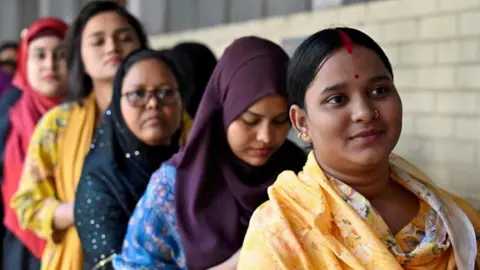
Voter turnout reached 49% by mid-afternoon, with approximately 120 million eligible to vote, many of whom are first-time participants in a political casting that serves as a referendum on the constitutional changes advocated by the interim government.
Interim Prime Minister Muhammad Yunus expressed optimism, suggesting that the nation is transitioning from a 'nightmare' to a promising 'dream.'
Among the candidates are Tarique Rahman from the BNP, campaigning for reform, and Shafiqur Rahman of Jamaat, who aims to address corruption and social justice. However, both parties historically correlate with dynastic politics, raising concerns among reformist factions.
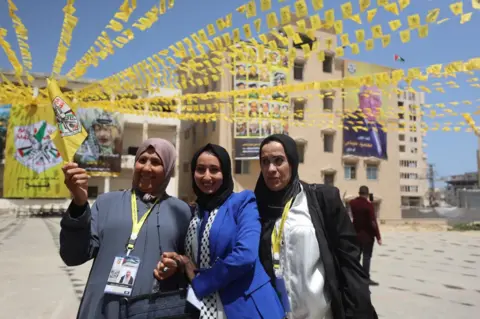
While the electoral process has re-engaged the population, the absence of female representation within the major parties remains a significant gap that many voters note, despite their crucial role during the uprisings. The vote represents not just a political choice, but a pivotal moment of hope for a populace eager for systemic change.
The political contest this time sees the Bangladesh Nationalist Party (BNP) face off with a coalition led by the Islamist Jamaat-e-Islami, signaling a potential shift in power dynamics within the country. Preliminary results are anticipated by Friday, with widespread expectations of reinstating a democratic process.
This election’s atmosphere is laden with uncertainty; it marks the first time since 2008 that the outcome cannot be easily quantified, and the previous elections during Hasina's tenure were characterized by accusations of systemic rigging.
Sheikh Hasina, currently exiled in India and facing a death sentence in absentia for her government’s violent crackdown on protesters—UN reports indicate that around 1,400 lives were lost—has rejected the legitimacy of the current election.
Voter turnout reached 49% by mid-afternoon, with approximately 120 million eligible to vote, many of whom are first-time participants in a political casting that serves as a referendum on the constitutional changes advocated by the interim government.
Interim Prime Minister Muhammad Yunus expressed optimism, suggesting that the nation is transitioning from a 'nightmare' to a promising 'dream.'
Among the candidates are Tarique Rahman from the BNP, campaigning for reform, and Shafiqur Rahman of Jamaat, who aims to address corruption and social justice. However, both parties historically correlate with dynastic politics, raising concerns among reformist factions.
While the electoral process has re-engaged the population, the absence of female representation within the major parties remains a significant gap that many voters note, despite their crucial role during the uprisings. The vote represents not just a political choice, but a pivotal moment of hope for a populace eager for systemic change.