In brief
Recent protests and graffiti at Dhaka University reflect a growing discontent among Bangladeshi youth regarding India's role in their political landscape. With a backdrop of a political upheaval following the ousting of former Prime Minister Sheikh Hasina, the relationship between India and Bangladesh is at a critical low, as younger generations voice their concerns over years of perceived intervention and autocratic governance backed by India. Amidst these dynamics, sentiments are shifting from longstanding grievances toward active resistance against perceived hegemony.
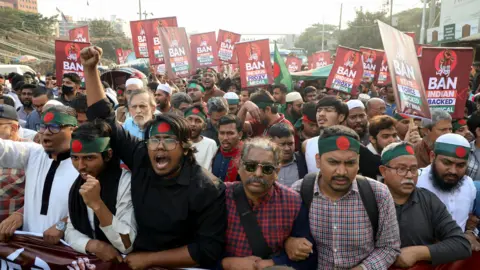
The walls of Dhaka University are screaming again. Graffiti - angry, witty, sometimes poetic - sprawls across walls and corridors, echoing the Gen Z-led July 2024 uprising that toppled Sheikh Hasina after 15 years in power. Once Bangladesh's pro-democracy icon, critics say she had grown increasingly autocratic. After her resignation, she fled to India.Students gather in knots, debating politics. On an unkempt lawn, red lanterns sway above a modest Chinese New Year celebration - a small but telling detail in a country where Beijing and Delhi are both vying hard for influence. For many here, the election scheduled for 12 February will be their first genuine encounter with the ballot box.Nobel peace-prize laureate Muhammad Yunus took charge days after Sheikh Hasina's fall. Hasina now lives in exile in Delhi, which has refused to return her to face a death sentence imposed in absentia over the brutal security crackdown in 2024 - violence in which the UN says around 1,400 people were killed, mostly by security forces. Her Awami League - the country's oldest party, which commanded some 30% of the popular vote - has been barred from contesting. Analysts say the main opposition Bangladesh Nationalist Party (BNP) is now moving to occupy the liberal-centrist space it has vacated. The main Islamist party, Jamaat-e-Islami, has joined forces with a party born out of the student uprising.But the slogans on the campus - and beyond - are not only about democracy at home. It increasingly points across the border. Dhaka, not Delhi is splashed on walls - and stitched onto saris, a traditional dress for women in South Asia. Among the young, hegemony has slipped into everyday speech, shorthand for India's long shadow over Bangladesh. The young generation feels India has been intervening in our country for many years, says Mosharraf Hossain, a 24-year-old sociology student. Especially after the 2014 election, which was basically a one-party election. That grievance - Delhi's perceived role in enabling Bangladesh's democratic erosion - sits at the heart of a sharp rise in anti-Indian sentiment.The result: India-Bangladesh relations, once touted as a model of neighbourhood diplomacy, are now at their lowest ebb in decades. Delhi is struggling in Dhaka because of deep anti-India sentiment in Bangladesh and a hardening, often a hostile turn, in India's own domestic political discourse towards its neighbour, says Avinash Paliwal, who teaches politics and international studies at SOAS University of London. Many blame Delhi for supporting an increasingly authoritarian Hasina in her final years and see India as an overbearing neighbour. They remember disputed general elections in 2014, 2018, and 2024 and Delhi's endorsement of them.India supported Hasina's regime without any pressure, without any questions, Hossain says. People think the destruction of democracy was supported by India. That sense of betrayal has merged with longer-standing grievances - border killings, water-sharing disputes, trade restrictions and inflammatory rhetoric from Indian politicians and television studios - into a more corrosive belief: that India views Bangladesh less as a sovereign equal than as a pliant backyard.Local media is rife with reports that an Indian conglomerate supplying electricity to Bangladesh has been cheating the country - a charge the group denies. On Facebook, a key platform for political mobilisation, campaigns rage to ban a leading daily branded an 'Indian agent'. Both countries have suspended most visa services.Delhi's decision to bar a Bangladeshi cricketer from the Indian Premier League (IPL) and refusal to move Bangladesh's T20 World Cup matches from India to Sri Lanka has fed resentment across the border. Yet, amidst political strain and burgeoning anti-Indian sentiment, local voices emphasize that the conflict is primarily with the Indian state, not the people, highlighting a complex relationship defined by historical ties and current political realities. As Bangladesh prepares for its elections, the ongoing situation suggests a nuanced landscape of dissent, longing for autonomy, and the precarious nature of regional diplomacy.