Suttasitt Macky Pottasak is a typical candidate of Thailand's People's Party: young, idealistic and hardworking.
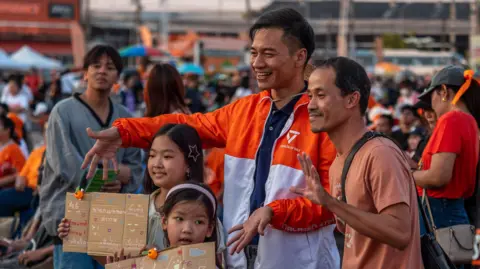
He gave up a career in TV drama production in Bangkok to run in the last election, winning a rural seat near his home city of Nakhon Ratchasima from an old, established political family. He has adopted the hat and flag of Luffy, the main character in the Japanese anime series One Piece, which has featured in recent youth protests in Asia. He makes light-hearted videos about his party's policies every day, which are getting millions of views on social media.
Politics is something past generations made boring. I want to make it fun, he says. That's why I brought in Luffy and my video mini-series. We don't have money to buy votes. We are just ordinary citizens, but with a strong determination to solve the long-standing problems. I think the villagers can see that.
Opinion polls suggest that much of the Thai public agrees with the People's Party. They are polling consistently ahead of their rivals as the election on Sunday draws near.
But in Thailand, winning an election is never enough.
The last one, less than three years ago, produced a surprise win for the progressive Move Forward party, which had campaigned on promises of root-and-branch political and economic reforms. These included making Thailand's powerful military, and its largest businesses, more accountable, and reducing the heavy punishments under the notorious lese majeste law.
However, powerful conservative forces, particularly the unelected senate and the constitutional court, blocked Move Forward from forming a government, dissolved the party and banned its leaders from politics. The court ruled that its proposals for the lese majeste law amounted to an attempt to overthrow the entire political system.
Now, after three tumultuous years of short-lived coalition administrations, the sacking of two prime ministers by the constitutional court and a border war with Cambodia, the reformists are making another bid for power, this time under a new name, the People's Party.
Their youthful energy and idealism still draw large and excited crowds. At a rally in Nakhon Ratchasima, the new party leader, Natthaphong Ruengpanyawut, a 38-year-old former software engineer, was mobbed like a rock star, with people queueing for selfies with him and wrapping him in garlands of flowers.
Macky and two assistants tour his constituency on e-scooters, passing irrigation canals, rice fields and the simple wooden houses characteristic of northeastern Thai villages, listening to the concerns of the residents. They tell a story of a society under acute economic stress, where the old engines of growth have stopped working.
With the elections approaching, all eyes are on what may unfold post-voting. Experts warn that, even with electoral victories, reformist parties like the People's Party may face concerted efforts to block their agenda by entrenched conservative institutions.