In brief
The recently signed EU-Australia trade deal, valued at approximately A$10 billion, aims to boost economic ties by eliminating tariffs on a wide range of goods. While the agreement is seen as mutually beneficial, it has drawn mixed reactions from agricultural stakeholders in both regions. Key elements include increased defense collaboration and critical mineral projects, reflecting a commitment to collective resilience in international trade.
In a significant step towards strengthening trade relations, Australia and the European Union have achieved a groundbreaking free trade agreement after eight years of negotiations.
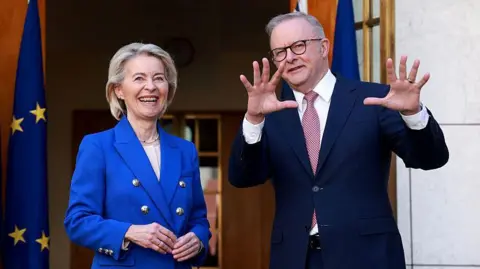
The deal signed in Canberra is worth about A$10bn ($7bn; £5.2bn) and was described as a mutual win-win by Australian Prime Minister Anthony Albanese and European Commission President Ursula von der Leyen.
This accord is notable for its emphasis on collective resilience in a swiftly changing world, as noted by von der Leyen during a news conference in Canberra.
Under the agreement, nearly all tariffs on trade will be removed, while both parties commit to enhance cooperation in defense and critical minerals, reflecting the urgency of adapting to evolving geopolitical dynamics.
Notably, European car manufacturers have expressed support for the agreement, while farmers in both regions expressed dissatisfaction over the export quotas for Australian beef and lamb, which they believe are insufficient.
Over the next decade, the volume of Australian beef permitted in the EU will increase dramatically, however, many Australian farmers are seeking even higher quotas due to market demand. European farmers, on the other hand, argue against these increases.
This agreement also illustrates the EU's ongoing strategy to diversify its global trade partnerships in response to a turbulent geopolitical climate.
Today we are telling an important story to a world that is deeply changing, von der Leyen stated, referencing the use of tariffs by major powers and the vulnerability of supply chains. She highlighted the unique, long-term relationship between Australia and the EU that transcends mere transactions.
What's in the deal? Beef, wine, and defense
The deal promises significant benefits, including the elimination of almost all EU tariffs on Australian agricultural products such as wine, fruits, vegetables, and dairy. Local winemakers are expected to save around A$37 million thanks to these measures, making European imports, including wine and pasta, more affordable for Australian consumers.
Controlled food naming rights have also been a point of contention; while some Australian produced goods will retain traditional names, future use will be subject to changing regulations.
The trade agreement presents a balanced approach, ensuring easier exports from Australia while broadening the availability of EU products in Australia.
However, concerns were raised regarding the capabilities and quotas set for meat exports. Australian livestock producers have emphasized that the quotas granted, although increased, fell short of market expectations.
In addition to trade, the deal incorporates increased security and defense collaboration, enabling cooperation across several sectors, including counter-terrorism and maritime security. It also pledges to foster joint projects focusing on critical minerals, particularly lithium and tungsten.
"tags": ["Australia", "European Union", "Trade", "Agriculture"]