In brief
The leadership landscape in Iran has become increasingly murky following the death of Ali Khamenei and the emergence of his son, Mojtaba, as the new supreme leader. Despite his formal authority, Mojtaba's visible absence and potential injuries raise questions about his capacity to govern effectively. Meanwhile, key decisions seem to be in the hands of military and parliamentary figures, leading to a fragmented decision-making process in the country. As diplomatic talks stall and military actions escalate, the coherence of Iran's political structure appears to be under strain.
The question hanging over Tehran since the opening strikes of Iran's current war with the US and Israel is simple: Who is in charge?
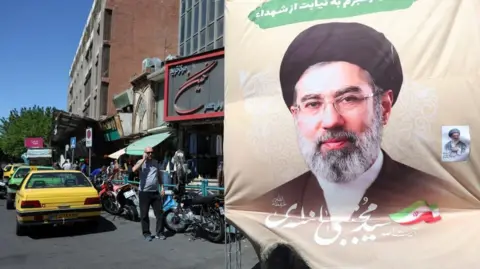
Formally, the answer is clear. Mojtaba Khamenei has assumed the role of supreme leader following the killing of his father, Ali Khamenei, on the first day of the war on 28 February. In the Islamic Republic's system, that position is meant to be decisive. The leader has the final word on almost anything important: war, peace, and the state's strategic direction.
But in practice, the picture is far murkier. Former President Donald Trump has described Iran's leadership as fractured and suggested the US is waiting for Tehran to produce a unified proposal.
Iran's leaders distributed a message to citizens recently stating that there was no division between hardliners and moderates, emphasizing national unity.
Invisible Leader
Despite his official title, Mojtaba Khamenei has not been seen in public since assuming power. With scarce written statements, including a notable claim regarding the closure of the Strait of Hormuz, there is limited evidence of his governance.
Reports suggest he may have sustained injuries in the initial strikes, casting doubt on his ability to manage the country effectively.
This absence is critical. Unlike his father, who was known for making public declarations to signal authority, Mojtaba's lack of visibility has left a vacuum in leadership perception.
Consequently, many question whether he has the capacity to assert control amidst wartime challenges.
Decision-making appears less centralized than it was prior to the conflict, creating a climate of uncertainty.
Diplomatic Channels Open but Uncertain
On paper, diplomacy is assigned to the government. Foreign Minister Abbas Araghchi represents Iran in discussions with the US, alongside President Masoud Pezeshkian. However, neither holds definitive strategy authority as Iran's delegation is led by parliamentary speaker Mohammad-Bagher Ghalibaf, whose influence continues to grow.
Even with channels remaining open, the rigidity of responses shows a hesitation to commit decisively to negotiations. This reflects a system where military actions increasingly dictate the pace of events, overshadowing political directives and diplomacy.
A Military Expanding Remit
The Islamic Revolutionary Guard Corps (IRGC) exercises considerable control over significant military decisions, including those related to the strategic Strait of Hormuz, complicating the chain of command further.
In this evolving landscape, figures like Ghalibaf have stepped forward amid the ambiguity. His combination of military background and authority in parliament allows him to traverse both ideological and pragmatic narratives. However, his position remains precarious given the underlying divisions that question his legitimacy.
Claimed or Exercised Coherence?
Overall, Iran's political structure remains functional but lacks coherent direction. The supreme leader's authority exists but appears dormant; the presidency and diplomatic efforts are present yet unlead; the military wields power without a clear overseer. This lack of consistent messaging complicates the critical decision-making needed in a time of crisis.
While the Islamic Republic remains intact and operational, it faces significant challenges in translating its leverage, particularly its strategic military options, into a clear, unified approach amidst overwhelming pressure.