In brief
At the Beijing Auto Show, BYD's executive vice president Stella Li asserts the company's resilience without the U.S. market. BYD, now the world's largest EV seller, is focusing on international expansion while addressing high demand for electric vehicles in regions like Europe and Brazil amidst rising fuel costs. The firm is leveraging innovative technology and production capacity to counter increasing competition, even as domestic sales face challenges.
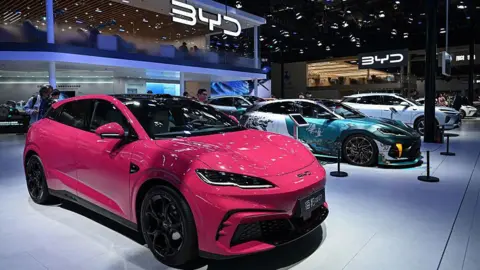
The recent surge in fuel prices due to the war in Iran has spurred demand for electric vehicles around the world, and Chinese car makers are making the most of the opportunity.China is the world's top producer of EVs, and while its manufacturers remain largely shut out of the major car market of the United States, they are benefiting from an uptick in interest and orders via dealerships across Asia and elsewhere.BYD, which overtook Tesla as the world's largest seller of electric vehicles last year and is expanding aggressively overseas, is at the centre of this shift in focus.We survive and are successful without the U.S. market today, BYD executive vice president Stella Li told the BBC at the Beijing Auto Show.Instead of aiming for U.S. customers, the company says its challenge is meeting increased demand in other regions, including Brazil, the UK and Europe.Consumers feel the daily savings when oil prices increase. EVs help them save money every day, Li said.Actually, we are now suffering [insufficient] capacity. Our demand is much higher than what we can supply.BYD is betting on its new flash charging technology which Li describes as a game-changer to help overcome one of the biggest barriers to EV adoption - concern over charging speeds.Flash charging can add hundreds of kilometres of range in minutes – a development Li said could persuade previously reluctant customers to consider an EV and allow BYD to compete more widely.At this year's Beijing Auto Show, now the largest industry event in the world, more than 1,400 vehicles from hundreds of Chinese and foreign companies were on display with Chinese carmakers centre stage.BYD's global push is unfolding against a complex geopolitical backdrop, with Chinese EV makers facing tariffs and scrutiny in global markets, especially in the U.S. The U.S. has criticized Chinese government subsidies and voiced concerns over data protection and national security.However, Li said the firm was winning greater brand recognition in other markets, including the UK, where they are increasingly competing on technology rather than just price.We are not just a car company. We produce one-third of global smartphone components, we are a leading player in battery storage, solar panels, buses, and trucks. So BYD is an ecosystem, she said.Though revenue continues to grow, the domestic Chinese market remains competitive and BYD's sales have dipped for seven consecutive months, while sales in Europe surged 156% in the early months of the year. Li posits that consolidation among manufacturers is becoming inevitable as the market rapidly evolves.Summing it up, as they navigate through changes and competition, BYD is set to challenge the global automotive landscape, fueled by innovative technology and expanding markets.}