In brief
Research reveals that the scents of mummies can provide new perspectives on ancient rituals and aid in their preservation efforts.
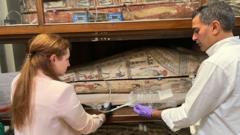
In a remarkable finding, scientists have discovered that mummified bodies from ancient Egypt emit aromas described as "woody," "spicy," and "sweet" despite having lain undisturbed for over 5,000 years. This delightful revelation stems from an investigation involving nine mummies, where researchers noted variations in scent intensity but overall pleasantness."We want to share the experience we had smelling the mummified bodies by reconstructing the smell for presentation in the Egyptian Museum in Cairo," shared researcher Cecilia Bembibre during a recent interview. This innovative approach aims to recreate the scent of mummified bodies, utilizing non-invasive techniques to extract odors from within the sarcophagus without disturbing the remains.The significance of scent in ancient Egyptian culture cannot be overstated; during the mummification process, the body was surrounded by pleasant fragrances to assist the spirit in its journey to the afterlife. Pharaohs and nobility were often adorned with various oils, waxes, and balms during this sacred ritual. Dr. Bembibre noted that this positive experience contrasts the ominous portrayals often depicted in films and books.The research was published in the Journal of the American Chemical Society and conducted by a team from UCL and the University of Ljubljana. Their methodology involved gas chromatography, which allowed them to differentiate and analyze the various scents emerging from the sarcophagus. Dr. Bembibre explained how this technique could also inform conservation efforts for mummies, as the fragrances could indicate the onset of decomposition and help conservators decide the best ways to preserve these artifacts for future generations.Engaging with scents offers a compelling way to connect with history. Ally Louks, an English literature supervisor at the University of Cambridge, highlighted the emotional and physical reactions that smells can evoke in visitors. "Smells were essential to social, religious, and personal practices in ancient Egypt," she stated. This breakthrough not only introduces a new sensory dimension to the museum experience but also paves the way for adopting similar methods across various museum collections. "This approach is potentially of huge interest for other types of artifacts," said Matija Strič, another team member. The captivating smells of ancient Egypt may soon be experienced in museums globally, showcasing the rich history of its civilization in an unprecedented way.