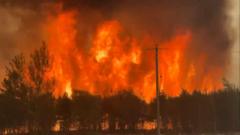
The Canadian province of Manitoba is undergoing a significant crisis as military aircraft and helicopters are actively evacuating residents amidst fast-moving wildfires. Thousands have already left several regions in western Canada, particularly in the central prairie provinces of Saskatchewan and Manitoba, as authorities confront increasing flames and dire weather predictions.
As of now, over 180 wildfires are reported across the country, with ominous smoke plumes affecting large areas not only in Canada but also reaching parts of the United States. Both Manitoba and Saskatchewan have declared states of emergency for the next month, seeking international assistance to combat the raging fires.
Aerial footage reveals vast clouds of smoke billowing from the fires, signaling a "rapidly evolving situation," particularly in the northern First Nations community of Pukatawagan, according to a Manitoba official. Canadian Armed Forces, along with Manitoba's Wildfire Service and Heavy Urban Search and Rescue Team, are mobilized to evacuate residents, with more than 2,000 still needing transportation from Pukatawagan.
While only firefighters and support personnel remain in Flin Flon—a city of 5,000—the situation across Manitoba is critical, with 25 active fires reported, 10 of which are categorized as out of control. In Saskatchewan, 16 wildfires are currently ablaze, with seven still uncontained, as conditions have been deemed extreme by the Canadian Interagency Forest Fire Centre (CIFFC).
Meteorologist Danielle Desjardins from Environment and Climate Change Canada highlighted that while a cold front may approach parts of Saskatchewan, it will not alleviate the dire conditions for areas currently affected by fires. The forecasted windy conditions, combined with high temperatures and dry spells, set the stage for further wildfire spread.
The smoke has also impacted air quality, leaving an estimated 22 million Americans under air quality advisories, particularly affecting states like Michigan and Wisconsin, where resident warnings are in effect over unhealthy smoke levels. This weekend's alerts continue through Monday evening.
2023 has become Canada's most devastating wildfire season on record, consuming over 42 million acres (17.3 million hectares). While wildfires occur naturally in various regions, climate change exacerbates the conditions that facilitate their spread, according to the UN climate body, leading to drier vegetation and prolonged heat periods.