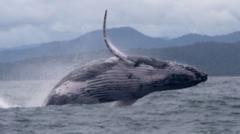
A humpback whale has astounded scientists with its extraordinary migration, reportedly one of the longest ever documented. The whale, initially observed off the Pacific coast of Colombia in 2017, reappeared years later near Zanzibar in the Indian Ocean, spanning an impressive distance of at least 13,000 km.
Experts suggest that climate change could be a contributing factor, either depleting the food supply or prompting the whale to seek new mating grounds. According to Ekaterina Kalashnikova from the Tanzania Cetaceans Program, this phenomenon is both "truly impressive and unusual" for this already well-known migratory species.
A photograph shows the same whale near Zanzibar in 2022, reinforcing its remarkable journey. Dr. Kalashnikova emphasized that this may be the longest recorded distance traveled by a humpback whale, which are known for their extensive migratory patterns across all oceans.
Humpback whales typically migrate from tropical breeding grounds to colder feeding areas, but this particular male’s route was extraordinary, incorporating two separate breeding locations. One theory posits that changes in climate may be affecting the availability of krill, a primary food source for the whales, thereby necessitating longer travels in search of nourishment.
Alternatively, it’s possible that the whale was searching for new breeding grounds as global conservation efforts permit population recovery. "While actual reasons are unknown, underlying causes may include worldwide climatic shifts, increased frequency of extreme environmental events, and evolutionary adaptations within the species," stated Dr. Kalashnikova.
The wandering whale was first photographed in a group off Colombia in 2013, later identified in both 2017 and again in 2022 off Zanzibar. The recorded sightings encompass a minimum distance of 13,046 km, though scientists note that the actual journey could be even longer due to the spherical nature of Earth.
These findings are based on extensive photo submissions from researchers, whale watchers, and the public to the citizen science platform happywhale.com, utilizing artificial intelligence to connect individual whale tail patterns and track movements globally. This research is detailed in the journal, Royal Society Open Science.
To learn further about humpback whales, check the documentary "The Secrets of Antarctica's Giants" available on BBC iPlayer.