Myanmar has denied committing genocide against the Rohingya people, asserting that The Gambia has failed to provide sufficient proof, as it began its defense at the UN's top court.
Ko Ko Hlaing, a Myanmar government representative, told judges at the International Court of Justice (ICJ) that the allegation was unsubstantiated.
Earlier this week, The Gambia's foreign minister Dawda Jallow informed the court that Myanmar was attempting to erase the minority Muslim population through its genocidal policies.
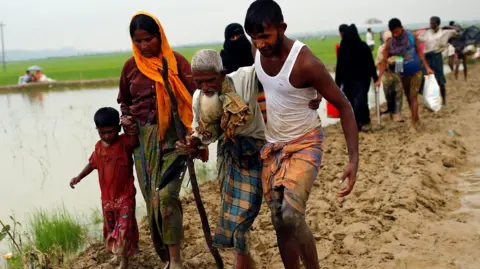
Thousands of Rohingya were killed and over 700,000 fled to neighboring Bangladesh during an army crackdown in Myanmar in 2017.
A damning report from the UN in the following year called for investigations into top military figures in Myanmar for genocide in Rakhine state and crimes against humanity elsewhere.
Myanmar, which has been under military control since it overthrew the civilian government in 2021, has continuously rejected the report and stated that its operations targeted militant or insurgent threats.
On Friday, Hlaing asserted that Myanmar was not obliged to remain idle and allow terrorists to have free reign of northern Rakhine states, where most Rohingya resided.
He claimed, These attacks were the reasons for the clearance operations, which is a military term referring to counter-insurgency or counter-terrorism operations.
The Gambia initiated its case against Myanmar in 2019, motivated by a sense of responsibility following its history with military rule.
Jallow described the Rohingya as having endured decades of severe persecution, culminating in military actions that aligned with their ongoing genocidal policies intended to erase their existence in Myanmar.
The courtroom debate highlighted the brutality inflicted upon women, children, and the elderly, arguing that such acts were unjustifiable under the pretext of combating terrorism.
With support from the Organization of Islamic Cooperation, it is asserted that the totality of actions against the Rohingya demonstrates a genocidal intent residing within state-led operations.
More than a million Rohingya refugees currently reside in Bangladesh's Cox's Bazar region, making it one of the largest refugee camps in the world.
Hlaing indicated Myanmar's commitment to repatriate individuals from Rakhine State now living in Bangladesh but noted external issues, including COVID-19, hinder progress.
He emphasized that finding Myanmar guilty of genocide would leave a permanent stain on the country and its people, making the case's outcome critically significant for Myanmar’s future.
The court is expected to hear testimonies from Rohingya survivors in private sessions, with a final ruling anticipated by late 2026, potentially influencing other genocide cases worldwide.