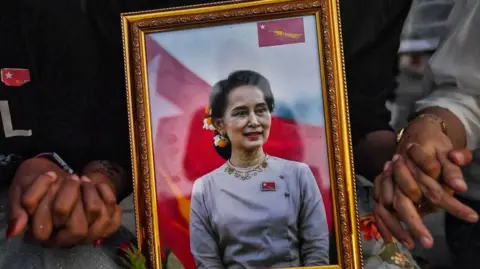
As of Wednesday the Burmese democracy campaigner Aung San Suu Kyi will have spent a total of 20 years in detention in Myanmar, five of them since her government was overthrown by a military coup in February 2021.
Almost nothing is known about her state of health, or the conditions she is living in, although she is presumed to be held in a military prison in the capital Nay Pyi Taw. For all I know she could be dead, her son Kim Aris said last month, although a spokesman for the ruling military junta insisted she is in good health.
She has not seen her lawyers for at least two years, nor is she known to have seen anyone else except prison personnel. After the coup she was given jail sentences totaling 27 years on what are widely viewed as fabricated charges.
Yet despite her disappearance from public view, she still casts a long shadow over Myanmar.
There are repeated calls for her release, along with appeals to the generals to end their ruinous campaign against the armed opposition and negotiate an end to the civil war that has now dragged on for five years.
The military has tried to remove her once ubiquitous image, but you still see faded posters of The Lady, or Amay Su, Mother Su, as she is affectionately known, in tucked away corners. Could she still play a role in settling the conflict between the soldiers and the people of Myanmar?
After all, it has happened before. Back in 2010 the military had been in power for nearly 50 years, brutally crushed all opposition and run the economy into the ground. Just as it is doing now, it organized a general election which excluded Aung San Suu Kyi's popular National League for Democracy, and which it ensured its own proxy party, the USDP, would win.
As with this election, which is still under way in phases, the one in 2010 was dismissed by most countries as a sham. Yet at the end of that year Aung San Suu Kyi was released, and within 18 months she had been elected an MP. By 2015 her party had won the first free election since 1960, and she was de facto leader of the country.
To the outside world it seemed an almost miraculous democratic transition, evidence perhaps that among the stony-faced generals there might be genuine reformers.
So could we see a re-run of that scenario once the junta has completed its three-stage election at the end of this month?
A lot has changed between then and now.
Back then there had been many years of engagement between the generals and an assortment of UN envoys, exploring ways to end their pariah status and re-engage with the rest of the world. It was a more optimistic era; the generals could see their South East Asian neighbours prospering through trade with the Western world, and they wanted an end to crippling economic sanctions.
They also sought better relations with the US as a counterbalance to their dependence on China, at a time when the Obama administration was making its celebrated pivot to Asia.
The top generals were still hard-line and suspicious, but there was a group of less senior officers keen to explore a political compromise.
It is not clear what finally persuaded the military leadership to open the country up, but they clearly believed their 2008 constitution, which guaranteed the armed forces one-quarter of the seats in a future parliament, would be enough, with their well-funded party, to limit Aung San Suu Kyi's influence once she was released.
They badly underestimated her massive star power, and they underestimated how much their decades of misrule had alienated most of the population.
In the 2015 election the USDP won just over 6% of the seats in both houses of parliament. In the next election in 2020 it expected to perform much better, after five years of an NLD administration which had started with impossibly high hopes, and had inevitably disappointed many of them. But the USDP fared even worse, winning just 5% of seats in the two houses.
Even many of those who were dissatisfied with Aung San Suu Kyi's performance in government still chose hers over the military's party. This raised the possibility that she might eventually win enough support to change the constitution, and end the military's privileged position.
It also ruled out the armed forces commander Min Aung Hlaing's hopes of becoming president after his retirement. He launched his coup on 1 February 2021, the day Aung San Suu Kyi was due to inaugurate her new government.
This time there are no reformers in the ranks, and no hopes of the kind of compromise which restored democracy back in 2010. The shocking violence used to put down protests against the coup has driven many young Burmese to take up arms against the junta. Tens of thousands have been killed, tens of thousands of homes have been destroyed. Attitudes on both sides have hardened.
The 15 years Aung San Suu Kyi was detained after 1989, under conditions of house arrest in her lakeside family home in Yangon, were very different from the conditions she is being held in today. Her dignified, non-violent resistance won her admirers across Myanmar and around the world, and during the occasional spells of freedom the military gave her she was able to give rousing speeches from her front gate, or interviews to journalists.
Today she is invisible. Her long-held belief in non-violent struggle has been rejected by those who have joined the armed resistance, who argue that they must fight to end the military's role in Myanmar's political life. There is a lot more criticism of how Aung San Suu Kyi governed when she was in power than before.
Her decision to lead Myanmar's defence against charges of genocide at the International Court of Justice over the military's atrocities against Muslim Rohingyas in 2017 badly tarnished her saint-like international image. It had much less resonance inside Myanmar, but many younger opposition activists are now willing to condemn how she handled the Rohingya crisis.
At the age of 80, with uncertain health, it is not clear how much influence she would have, were she to be released, even if she still wants to play a central role.
And yet her long struggle against military rule made her synonymous with all the hopes of a freer, more democratic future.
There is simply no-one else of her stature in Myanmar, and for that reason alone, many would argue, she is probably still needed if the country is to chart a path out of its current deadlock.