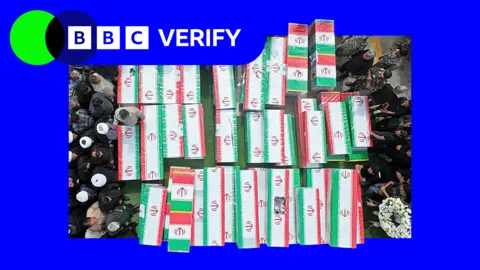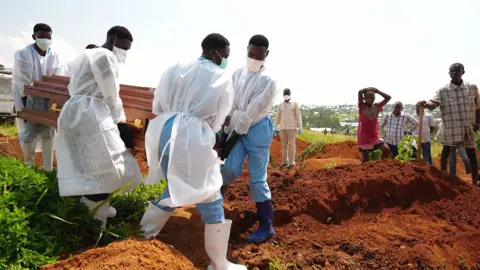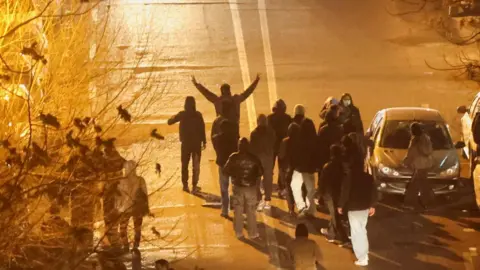
Families of people killed in the protests in Iran have told the BBC that the authorities are demanding large sums of money to return their bodies for burial. Multiple sources have told BBC Persian that bodies are being held in mortuaries and hospitals and that security forces will not release them unless their relatives hand over money. At least 2,435 people have been killed during more than two weeks of protests across the country.
One family in the northern city of Rasht told the BBC that security forces demanded 700 million tomans ($5,000; £3,700) to release the body of their loved one. It was being held at the Poursina Hospital mortuary, along with at least 70 other dead protesters. Meanwhile in Tehran, the family of a Kurdish seasonal construction worker went to collect his body, only to be told they must pay a billion tomans ($7,000; £5,200) to receive it. The family expressed their inability to afford the fee and left without their son's body, emphasizing the stark reality of earnings, where a construction worker in Iran typically makes less than $100 a month.
In some instances, hospital staff have preemptively notified families to come collect the bodies before the authorities can extort money. A woman was informed of her husband’s death through a phone call from hospital staff, who advised her to quickly retrieve his body. She drove for seven hours with her two children to bury him, recounting her sorrow as she cried in the back of the pickup truck.
Further distressing reports indicate that officials at Tehran's Behesht-e Zahra mortuary have been offering to release bodies without charge if families falsely claim the deceased as members of a pro-government paramilitary group.
As the unrest continues, families are resorting to desperate measures, with reports of several breaking into mortuaries to retrieve bodies for fear of being denied access. The Iranian government has instituted a communications blackout, complicating efforts to fully understand the situation on the ground as protests erupted following economic woes and violent crackdowns have resulted in thousands of deaths, as documented by the US-based Human Rights Activists News Agency (HRANA).
One family in the northern city of Rasht told the BBC that security forces demanded 700 million tomans ($5,000; £3,700) to release the body of their loved one. It was being held at the Poursina Hospital mortuary, along with at least 70 other dead protesters. Meanwhile in Tehran, the family of a Kurdish seasonal construction worker went to collect his body, only to be told they must pay a billion tomans ($7,000; £5,200) to receive it. The family expressed their inability to afford the fee and left without their son's body, emphasizing the stark reality of earnings, where a construction worker in Iran typically makes less than $100 a month.
In some instances, hospital staff have preemptively notified families to come collect the bodies before the authorities can extort money. A woman was informed of her husband’s death through a phone call from hospital staff, who advised her to quickly retrieve his body. She drove for seven hours with her two children to bury him, recounting her sorrow as she cried in the back of the pickup truck.
Further distressing reports indicate that officials at Tehran's Behesht-e Zahra mortuary have been offering to release bodies without charge if families falsely claim the deceased as members of a pro-government paramilitary group.
As the unrest continues, families are resorting to desperate measures, with reports of several breaking into mortuaries to retrieve bodies for fear of being denied access. The Iranian government has instituted a communications blackout, complicating efforts to fully understand the situation on the ground as protests erupted following economic woes and violent crackdowns have resulted in thousands of deaths, as documented by the US-based Human Rights Activists News Agency (HRANA).