On the shores of Mumbai's Powai lake - a rare pocket of serenity in the bustling metropolis of more than 20 million people - a glitzy new campus of the University of York is getting its final finishing touches.
The institute has begun recruiting students for the 2026-27 academic year, and operations are set to commence in the next few months.
We're looking at an intake of around 270 students in the first year... and that should go up to 3,000-4,000 students each year over the coming years, Lindsay Oades, provost of the University of York in Mumbai, told the BBC.
York is among nine UK universities that are setting up campuses in India following announcements last year during Sir Keir Starmer's visit to the country. Others include the University of Aberdeen, University of Bristol, University of Liverpool, Queen's University Belfast, and Coventry University.
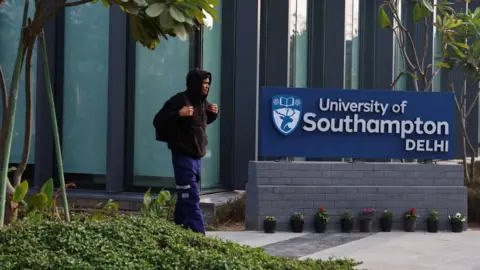
The campus of the University of Southampton has already opened a campus in the capital Delhi. Most of these planned campuses are expected to focus primarily on business, management, and engineering programmes.
In 2020, India's National Education Policy announced that foreign universities would be allowed in the country and rules were notified in 2023, creating a legal mechanism for these institutions to set up shop.
Ostensibly, the proposition appears like a win-win for UK universities facing severe fiscal pressures at home, as well as for Indian students starved of quality education locally. However, expanding on the ground will be easier said than done.
According to UK government figures, India has 40 million university students and would need at least 70 million places in the decade to 2035, opening up an incremental market opportunity of 25-30 million seats for British universities. Moreover, there's a clear supply gap in high-quality education.
Eleven million students complete Grade 12 each year, with roughly 1.5-1.7 million falling within the top academic bracket. India's top-tier institutions admit only about 200,000 of them annually.
From an affordability standpoint, an estimated four-five million students can realistically consider degree programmes priced above £10,000 per year. That's essentially the aspirational upper middle class and not the mass market, but a large enough gap for British universities to exploit.
According to Oades, fees at York's Indian campus will be priced at around 50% of what it would cost to study at the university's campus in the UK. While still much more expensive than many Indian private universities, there is a straight-up quality justification for the premium, focusing on the demand for employability skills and industry partnerships.
The courses will also allow students to opt for hybrid learning between the Mumbai and York campuses, which may enhance the appeal.
However, will this be enough? For decades millions of Indian students have opted to study abroad, largely drawn by the prospect of better work opportunities.
Mumbai-based Ankita Kejriwal, whose son Vivaan is hoping to study finance and economics in the US next year, notes that most of his friends and cousins are choosing to go abroad primarily for international work exposure. That is the main draw. They may choose to come back in a few years, but not without working there at least for a while, she says.
An India-delivered UK degree may not be as alluring for such students. However, tighter immigration rules abroad could provide some encouragement to explore foreign university experiences in India.
The success of these domestic campuses will hinge on various factors, including maintaining UK academic standards at Indian price points, navigating regulatory environments, and partnering with Indian industry. Initially, enrolment is expected to be in the low hundreds, gradually rising over a five-to-seven year horizon as alumni outcomes become known and employer acceptance stabilizes.
At the same time, infrastructural challenges loom large with reports suggesting that $100 billion will be required to create the necessary academic facilities to meet surging demand.
As UK universities make strides into India, the landscape of higher education may soon witness transformational shifts, but the journey is fraught with complexities that must be navigated carefully.