In brief
Once a rising star in India's comedy scene, Samay Raina faced severe backlash following a controversial incident on his popular show. After months away from the public eye, he makes a poignant return with his stand-up special, 'Still Alive,' which delves into themes of cancellation, mental health, and the complexities of online fame. Raina's journey is emblematic of the evolving landscape of Indian comedy, balancing authenticity with the inherent risks of modern-day performance.
In an Indian city, an unassuming, slightly rumpled comedian walks into the spotlight for the first time in months.
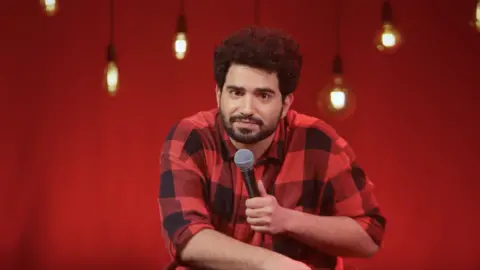
Tousle-haired and clad in a checked shirt, Samay Raina half smiles on stage, as if a punchline is already poised at the edge of his lips. The audience laughs even before he begins speaking.
Until a year ago, Raina was at the top of India's burgeoning comedy scene, with millions of views online and sold-out shows across India and the world. His flagship YouTube show, India's Got Latent - a ragged, exuberant parody of talent competitions - had become an online phenomenon, blending absurd humour with sharp improvisation to capture the sensibilities of a generation raised on streaming culture.
Then, a joke uttered by someone else on the show brought everything crashing down.
Trouble began after one of the guests, podcaster Ranveer Allahbadia - who is better known as BeerBiceps to his millions of followers - asked a contestant an explicit and widely criticised question. Police complaints were filed alleging obscenity and a case was registered against the participants, including Raina. The fallout escalated when Raina's editor was arrested, prompting him to take down the entire series.
The controversy nearly ended his career. For months, he largely stayed off camera, avoiding public life.
Now, the 29-year-old comic is back, using the very thing that derailed him - humour - as his way of reclaiming the spotlight. Earlier this week, he released Still Alive - a YouTube stand-up special that reviewers have described as his boldest and most personal work yet.
The set blends humour and reflection, addressing his professional hiatus and the volatility of online fame: what it means to build a public identity in today's internet culture; the particular hell of losing it all, and how vulnerable he felt through it. Once brash and unapologetic, his humour now carries a quiet melancholy - yet it lands with the precise timing of someone who has learned what it takes to survive.
In one of the episode's more poignant moments, Raina spoke about battling anxiety before performances, admitting that the pressure of returning to the stage often left him physically shaken. Moving clips of him describing feeling broken and how he struggled to answer his mother's calls have since gone viral.
His experience mirrors a wider shift in Indian comedy. What was once a small, urban, English-speaking circuit has grown into a far bigger, more diverse scene, powered by YouTube and Instagram. However, with that expansion has come new pressures. Comics today operate with greater visibility and greater scrutiny. In Still Alive, Samay Raina gestures to that fragile balance: how jokes, once released into the online world, can travel far beyond their original context, taking on new meanings, and sometimes carry serious consequences.
Rather than reinventing himself, Raina seems to be adjusting his approach - testing how far his loose, spontaneous style can go without breaking. There is no neat conclusion to this moment in his career. The controversy has not entirely faded and the risks of doing boundary-defying comedy remain. But if Still Alive is any indication, Raina is less interested in resolution than in continuation. For fans, the special is not an apology, it's a reassertion - of his voice and his refusal to be flattened. I'm still here, he says towards the end, with a shrug that lands somewhere between defiance and a punchline, and I am going to do whatever I want.\