In brief
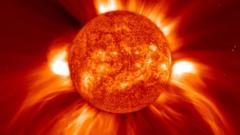
Scientists from India's first solar observation mission, Aditya-L1, celebrated a major breakthrough with their first findings on coronal mass ejections (CMEs), which are massive explosive events from the Sun. This information is crucial for monitoring solar activity, predicting potential impacts on Earth's weather and satellite systems, and understanding cosmic phenomena.
The successful mission led to the capture of critical data on July 16, assessing the timing of a CME's onset and its trajectory. Prof. R Ramesh, the Principal Investigator for the Visible Emission Line Coronagraph (Velc) on the spacecraft, reported that a CME that started at 13:08 GMT was initially directed towards Earth but later veered off into space. Although it did not impact Earth, the data obtained allows for a better understanding of CMEs, which release billions of tons of energy and can affect technologies on Earth and in space.Coronal mass ejections can cause disturbances in Earth's magnetic field, disrupting satellites and electrical grids. Modern society's reliance on communication satellites makes studying CMEs critical—solar storms can lead to significant disruptions in telecommunication systems. Notably, the historical Carrington Event of 1859 caused widespread telegraph outages globally, illustrating the potential risks involved.Aditya-L1's continuous monitoring capability, stemming from its position in space, surpasses earth-based observations. Such an advantage enables scientists to detect solar events in real time and anticipate their trajectories, offering an opportunity to prepare against potential disruptions.With Aditya-L1 now operational, India joins other countries engaged in solar studies, enriching global research on solar weather and its potential impacts. Besides this mission, India also benefits from ground observatories enhancing its solar research efforts, providing a holistic view of solar phenomena.The interplay between the Sun's activity and its profound implications for technology and life on Earth underscores the importance of ongoing solar research, which Aditya-L1 promises to advance.