In brief
The Philippine government has made serious allegations against Chinese fishermen, claiming they have been dumping cyanide into waters around the Spratly Islands. This practice, described as sabotaging local fish populations, is said to threaten food supplies for Filipino troops stationed at Second Thomas Shoal. China has dismissed the accusations as unfounded. The dispute adds another layer to the already tense relations in the South China Sea, where territorial claims are heavily contested.
The Philippines has accused Chinese fishermen of dumping cyanide in waters around the Spratly Islands, a fiercely contested area in the South China Sea.
Manila described the alleged poisoning as an act of sabotage intended to kill local fish populations and deprive Filipino troops stationed at Second Thomas Shoal of a crucial food source.
China dismissed the claim as a farce. The allegation follows years of tense stand-offs and occasional violent confrontations between Philippine and Chinese vessels in the disputed waters.
The South China Sea is at the centre of a territorial dispute between China, the Philippines and other countries.
Chinese foreign ministry spokesman Guo Jiakin said the accusation was completely unbelievable and not even worth refuting.
He added that the Philippines has illegally harassed Chinese fishing vessels engaged in normal fishing activities.
The Philippine National Security Council (NSC) stated that the alleged poisoning began last year around Second Thomas Shoal, part of the Spratly archipelago in the South China Sea.
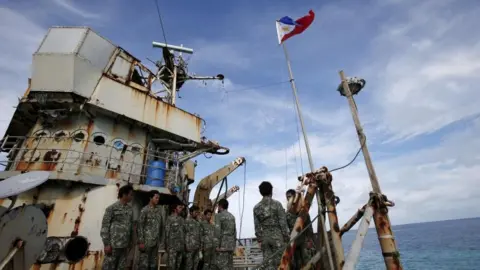
The reef is home to a small Philippine military outpost aboard the BRP Sierra Madre, a rusting World War Two-era ship deliberately grounded there in 1999 to assert Manila's claim to the territory.
NSC assistant director-general Cornelio Valencia expressed that the use of cyanide was intended to kill local fish populations, depriving Navy personnel of a vital food source. He noted that it posed health risks to troops and could damage the coral reefs vital for the vessel's structural foundations.
Valencia mentioned that Manila raised the alleged poisoning with Beijing at a recent meeting but received no formal response. The NSC intends to submit a report to the foreign ministry that could form the basis of a diplomatic protest.
The navy and coastguard have been ordered to increase patrols in the area.
Philippine Navy spokesman Rear Adm Roy Vincent Trinidad reported that troops had seized 10 bottles of cyanide from boats allegedly launched from Chinese fishing vessels in recent months.
Cyanide fishing has historically been used in parts of Southeast Asia, but it is illegal in the Philippines and widely banned due to its devastating impact on marine ecosystems.
The South China Sea is vital for trade and home to rich fishing grounds, with overlapping territorial claims from several countries, including Vietnam, Taiwan, Malaysia, and Brunei.
China claims the sea nearly entirely, despite a 2016 international tribunal ruling invalidating its claims. The Philippines bases its claim on geographical proximity to the Spratly Islands.
Both nations also lay claim to the Scarborough Shoal, which is closer to the Philippines, highlighting the strained relations and rising tensions in recent years.
In March, the Philippines signed a military deal with France, involving the deployment of troops for upcoming joint exercises, further heightening Beijing's criticism of such drills.