In brief
The Democratic Republic of Congo has accepted its first group of deportees from the United States, consisting of fifteen individuals primarily from South America. This marks the beginning of a controversial agreement between the two nations, where the DR Congo has committed to providing temporary refuge for these deportees. The US has intensified its immigration enforcement efforts under the Trump administration, leading to deportations to several African countries as part of a broader strategy to regain control over immigration.
Fifteen people deported from the US, who are reportedly from South America, have arrived in the Democratic Republic of Congo.
This is the first group of an unknown number of people that the US has expelled which the DR Congo had agreed to take in.
The government in Kinshasa has stressed that their stay in the country is only temporary and that Washington is funding their reception, support, and care.
The US has already sent deportees to several other African countries, including Ghana, South Sudan, and Eswatini, as part of the crackdown on immigration.
Earlier this month, when details of the deportation deal first emerged, the Congolese government said the decision to receive what are known as third-country migrants - those who come from neither the sending nor receiving nation - aligns with its commitment to human dignity and protecting the rights of migrants.
The Congolese authorities also stated that the scheme was not intended as a permanent relocation mechanism or outsourcing of migration policies.
The US State Department has not commented directly on diplomatic communications but maintained its commitment to ending illegal immigration and enhancing border security.
Since President Trump took office, the US has deported numerous individuals to third countries as part of its firm stance on immigration.
A government statement indicated that affected individuals are granted short-stay permits, following national laws regarding the entry and residency of foreigners.
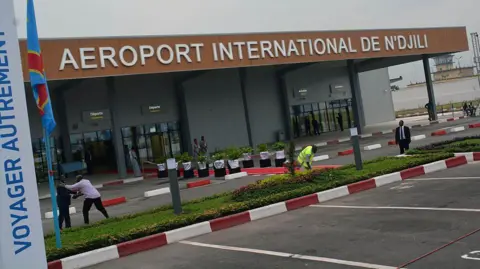
Sources at N'djili International Airport noted that the recent arrivals predominantly include Colombians and Peruvians.
According to a minority report from the US Senate’s Committee on Foreign Relations, the Trump administration may have spent over $40 million on third-country deportations as of January 2026, with additional funds supplied directly to nations including Equatorial Guinea, Rwanda, and El Salvador.
Moreover, the US is negotiating a minerals deal with DR Congo to secure access to the country's rich reserves of essential metals like cobalt, tantalum, lithium, and copper, while also facilitating dialogues for peace between DR Congo and Rwanda amidst ongoing regional conflicts.