In brief
Iran's recent missile launches aimed at the US-UK base in Diego Garcia have sparked speculation about their potential to reach European capitals like London and Paris. Despite ongoing doubts about their long-range effectiveness, experts suggest that some of Iran's missiles may indeed be capable of covering such distances. The global community remains watchful, with both the US and UK monitoring developments closely.
Iranian missiles have attempted to target the joint US-UK military base at Diego Garcia in the Indian Ocean, pushing the global community to reconsider the potential range of these weapons.
Last Friday, two missiles were launched—one failed and the other was intercepted, according to UK Defence Secretary John Healey. Located nearly 4,000km from Iran, this incident raises alarms regarding Iran's missile capabilities, leading to fears that they could target much of Europe, including London and Paris.
While doubts linger about the efficacy of Iranian missiles at such distances, analysis indicates that one missile reportedly managed to travel approximately 3,000km.
The implications of Iran's missile capabilities extend beyond their ability to reach distant targets. The US Space Force has been closely monitoring missile launches from Iran utilizing sophisticated detection systems that can track trajectories globally.
Concerning the specifics, experts remain skeptical, citing that Iran has often overstated its technological advancements. Tehran has previously claimed to have limited missile ranges to 2,000km, yet Israel suggests that they may actually possess missiles with ranges up to 4,000km, capable of striking significant locations in Europe.
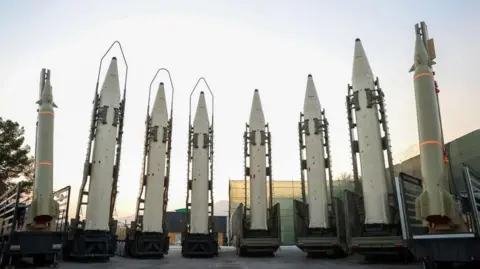
In the case of the missiles fired at Diego Garcia, their range capabilities are under scrutiny. Various analysts suspect a version of Iran's Khorramshah missile—which is derived from North Korean design—may have been used, indicating the possibility of higher ranges when adapting warhead weights.
Nevertheless, experts believe that the overall threat to London remains low. The notion of Iranian missiles being able to hit London has been acknowledged, yet concerns emphasize the inaccuracy and the small number of such missiles, compounded by a significant air defense infrastructure surrounding the UK.
As tensions rise, the situation continues to be monitored closely. Analysts conclude that while Iran's missile capabilities may increase concern, the practicality and reliability of these systems in striking major European cities are still uncertain.