In brief
In 2025, Africa faced a series of political upheavals that tested the foundations of democracy across the continent. Notable events included violent protests in Tanzania against allegedly rigged elections, military coups in several countries, and a general trend towards authoritarianism. Despite these challenges, there were instances of democratic progress, including peaceful transitions of power in Malawi and Seychelles. The growing disconnection between youthful populations and aging leaders raises questions about the future of governance in Africa.
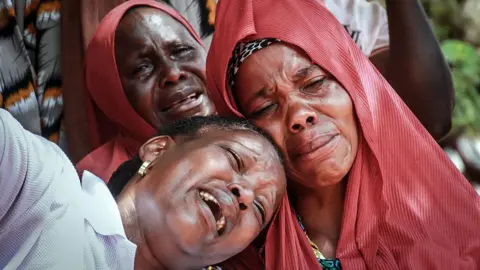
October's shocking events in Tanzania offer a snapshot of some of the tensions which have shaped a difficult year for African politics.
Demonstrators were shot dead by police while protesting against what they saw as a rigged election - condemned by regional and continental bodies - shattering the country's reputation for peace and stability.
With opposition candidates either imprisoned or barred from running, President Samia Suluhu Hassan was elected with 98% of the votes.
Arguably what happened there highlighted a broader breakdown in many African nations between the people and those who govern them.
Several countries saw protests and election disputes in 2025, while military leaders cemented their power in others, with analysts believing next year could bring more upheaval.
If we look at the overall picture across the continent, the trend is worrying, said Mo Ibrahim, whose foundation analyses data to assess the state of African governance.
Its most recent report suggests that in its measure of governance, which includes things like security, participation in decision-making and the state of health and education, progress has stalled when compared to the decade up to 2022.
The increase in coups [in recent years], the return of military governments and the closing of democratic space all point to the same problem: a failure of governance.
The spike in the cost of living has been the spark that lit the fire of dissatisfaction in many places. This was not unique to the continent but, as Mr Ibrahim told the BBC, the risk for Africa is that these negative patterns spread unchecked, much of the hard-won progress achieved over recent decades could be reversed.
For those who believe that democracy is the best way to channel the demands of the population, there have been some points of positivity in 2025 with peaceful transfers of power and free and fair elections. In Malawi, the country's former leader Peter Mutharika won back the presidency after a period in opposition. Seychelles saw long-term ruling party United Seychelles returned to office, five years after losing power.
But analysts point to shifts elsewhere as evidence that democracy on the continent is being challenged. Perhaps no more so than through the consolidation of the power of military-led governments across West Africa's Sahel region.
In Tanzania, the protests did not lead to change. But for those considering direct action elsewhere, there were lessons in 2025 of how protest can produce results. In September, the Indian Ocean island nation of Madagascar was rocked by weeks of youth-led protests against poor service delivery, forcing the country's President Andry Rajoelina to sack his entire cabinet. However, the protests continued, and he was deposed in a coup later that year.
Many analysts believe demonstrations could be a growing feature of Africa's politics.
This sentiment was echoed by Adem Abebe, senior adviser to the International Institute for Democracy and Electoral Assistance, who emphasized the growing public disillusionment with governance across the continent.
The approaching 2026 elections in nations like Uganda, already under scrutiny for allegations of irregularities and violence, will further test the resilience of democracy in Africa. With young leaders increasingly demanding accountability amidst a backdrop of elder administrations, the next few years might prove pivotal for governance on the continent.