In brief
Researchers have discovered volcanic rock fragments from the Moon's far side, dating back over 4.2 billion years, thanks to samples collected by China's Chang’e-6 mission.
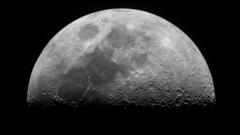
The findings, published in reputable scientific journals, highlight a previously unexplored geological landscape rich in volcanic activity.In a groundbreaking discovery, scientists have confirmed that volcanoes were once active on the Moon's mysterious far side billions of years ago. This revelation comes from detailed analysis of rock and dust samples collected by the Chang’e-6 mission, which returned fragments of basalt—volcanic rock formed during eruptions—dating over 4.2 billion years old. These findings were shared in prominent publications this past Friday.While the near side of the Moon, visible from Earth, has long been known to exhibit volcanic activity, the geology of the far side remains largely enigmatic and underserved by exploration efforts. The Chang’e-6 spacecraft undertook a nearly two-month mission filled with challenges to retrieve these first-ever samples from the Moon's hidden surface.The research team, led by experts from the Chinese Academy of Sciences, employed radiometric dating techniques to ascertain the age of the volcanic rock. Among their significant discoveries was evidence of a "surprisingly young" eruption occurring approximately 2.83 billion years ago, which contrasts sharply with findings related to the near side."This is an incredibly exciting study," commented Professor Qiuli Li, a peer reviewer from the Institute of Geology and Geophysics. He emphasized the study’s groundbreaking nature in understanding lunar and planetary science, marking it as the first geochronology analysis emerging from the Chang’e-6 samples.Despite commonly being referred to as the "dark side," this region of the Moon receives ample sunlight; however, it is not visible from Earth due to the Moon’s tidal locking, which keeps the same side facing our planet as it orbits.The initial glimpse of the far side was captured in 1959 by the Soviet spacecraft Luna 3, revealing grainy photos that intrigued scientists and the public alike. Since then, better-quality images have emerged, including an impressive NASA video showcasing the far side with Earth in the backdrop. Earlier this year, during the Chang’e-6 mission, a small rover even took a selfie of the lunar lander atop the rugged terrain of the far side.With these findings, researchers hope to deepen our understanding of not just lunar geology, but also the broader context of planetary formation and volcanic activity in the solar system.