In brief
Despite varying political agendas and economic dependence, the relationship between China and Russia is often framed as a 'friendship with no limits.' As they navigate their shared interests against a backdrop of Western pressure, both nations underscore their commitment to this partnership while recognizing the inherent asymmetries. Analysts suggest China's dominance in economic terms while noting Russia's strategic role, particularly in military technologies amid the ongoing Ukraine conflict. Ultimately, the longevity of their alliance appears secure despite potential divergences.
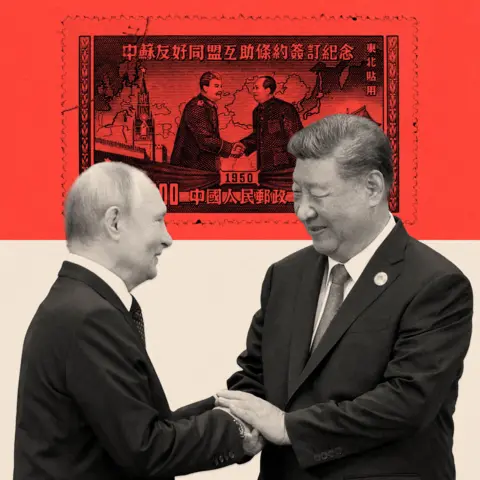
As they strolled through Tiananmen Square in Beijing last September, Chinese President Xi Jinping and Russian President Vladimir Putin appeared to muse over the possibility that organ transplants could dramatically extend human life.
Human organs can be continuously transplanted. The longer you live, the younger you become, and even achieve immortality, Putin's interpreter was heard saying.
Some predict that in this century, humans may live up to 150 years old, Xi's interpreter was heard responding.
This conversation reflects the strongmen's rapport, partners in a complex relationship that remains often misunderstood. Putin is set to visit Beijing again, marking the 25th anniversary of their Treaty of Good-Neighbourliness and Friendly Cooperation.
The relationship is characterized by an imbalance: while Russia aligns with China, it's on China's terms, underscoring a dynamic that analysts argue leaves Russia as a dependent player in the partnership.
On Chinese Terms
China is Russia's largest trading partner, while Russia only comprises about 4% of China's trade. With the West's sanctions pushing Russia closer to China for economic survival, there is a significant shift in dependence, notably with technology.
Amid its ongoing war in Ukraine, Russia has become reliant on Chinese technology, importing over 90% of sanctioned goods from China, further solidifying this uneven partnership.
Partners, Not Allies
Despite appearing to be allies in opposition to Western influence, China and Russia have a flexible relationship that does not constitute a formal alliance. This flexibility may yield resilience through their shared interests and historical ties.
Both leaders have significant political motives for their relationship, often depicted as a 'friendship with no limits.' This connection is tested by tensions arising from diverging pathways, yet remains intact due to their mutual need for a cooperative stance.
As Russia shoulders its military aspirations, China benefits from it strategically while maintaining its own cautious approach toward international relations.
The Human Side
While geopolitical alliances dominate discussions of Sino-Russian ties, cultural connections are also significant. Russian bureaucrats frequently engage with their Chinese counterparts, despite some skepticism about the real cultural affinity.
Nonetheless, there is growing interconnectedness, with easier travel and increasing familiarity between the societies serving to deepen ties amid evolving geopolitics.
Overall, while the Sino-Russian partnership may possess inherent vulnerabilities, analysts agree that it is likely to endure in the near term, driven by the lack of viable alternatives and mutual interests.
Top picture credit: Getty Images