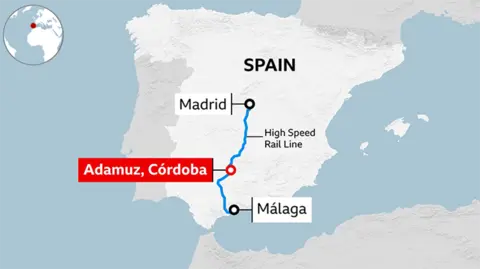
At least 39 people have died in a train collision in southern Spain and dozens more have been injured in the country's worst rail crash in more than a decade, Spain's Civil Guard has reported. Carriages on a Madrid-bound train derailed and crossed over to the opposite tracks, colliding with an oncoming train in Adamuz on Sunday evening.
Four hundred passengers and staff were onboard both trains, the rail networks confirmed. Emergency services treated 122 people, with 43, including four children, still hospitalized. Among those, 12 adults and one child are in intensive care.
Spanish Transport Minister Óscar Puente remarked that the death toll 'is not yet final', as officials have initiated an investigation into the cause of the collision. This tragic incident has been described as 'extremely strange' by Puente, mentioning that railway experts are baffled by the accident.
The collision occurred at 19:45 local time on a straight stretch of track near Córdoba, an hour after the train departed Málaga for Madrid. The force of the crash resulted in significant damage, with most fatalities occurring among passengers in the front carriages of the second train, which was traveling from Madrid to Huelva. The crash involved a Freccia 1000 train capable of reaching speeds up to 400 km/h (250 mph).
Rescue teams have faced challenges due to the wreckage, requiring them to prioritize rescue efforts while unfortunately having to move deceased individuals to reach living victims. Footage from the scene depicts the chaos as emergency workers worked diligently to extract trapped passengers.
All rail services between Madrid and Andalusia have been suspended indefinitely following the accident. Iryo, the private rail company responsible for the derailed train, reported that approximately 300 passengers were onboard, while the state-operated Renfe train had around 100 passengers.
The official cause of the incident remains undetermined, and Transport Minister Puente has stated that it may take a month before an initial understanding of the accident is reached. Prime Minister Pedro Sánchez expressed condolences, referring to the event as a 'night of deep pain'. Leaders from several European nations, including French President Emmanuel Macron and Italian Prime Minister Giorgia Meloni, have also extended their sympathies to the victims and their families. Meanwhile, the emergency agency has encouraged survivors to contact their families or use social media to confirm their safety.
Four hundred passengers and staff were onboard both trains, the rail networks confirmed. Emergency services treated 122 people, with 43, including four children, still hospitalized. Among those, 12 adults and one child are in intensive care.
Spanish Transport Minister Óscar Puente remarked that the death toll 'is not yet final', as officials have initiated an investigation into the cause of the collision. This tragic incident has been described as 'extremely strange' by Puente, mentioning that railway experts are baffled by the accident.
The collision occurred at 19:45 local time on a straight stretch of track near Córdoba, an hour after the train departed Málaga for Madrid. The force of the crash resulted in significant damage, with most fatalities occurring among passengers in the front carriages of the second train, which was traveling from Madrid to Huelva. The crash involved a Freccia 1000 train capable of reaching speeds up to 400 km/h (250 mph).
Rescue teams have faced challenges due to the wreckage, requiring them to prioritize rescue efforts while unfortunately having to move deceased individuals to reach living victims. Footage from the scene depicts the chaos as emergency workers worked diligently to extract trapped passengers.
All rail services between Madrid and Andalusia have been suspended indefinitely following the accident. Iryo, the private rail company responsible for the derailed train, reported that approximately 300 passengers were onboard, while the state-operated Renfe train had around 100 passengers.
The official cause of the incident remains undetermined, and Transport Minister Puente has stated that it may take a month before an initial understanding of the accident is reached. Prime Minister Pedro Sánchez expressed condolences, referring to the event as a 'night of deep pain'. Leaders from several European nations, including French President Emmanuel Macron and Italian Prime Minister Giorgia Meloni, have also extended their sympathies to the victims and their families. Meanwhile, the emergency agency has encouraged survivors to contact their families or use social media to confirm their safety.