In brief
The spacecraft, launched to study solar phenomena, successfully withstood extreme conditions as it approached the solar corona.
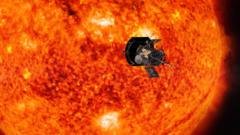
NASA's Parker Solar Probe has made history by executing the closest-ever fly-by of the Sun, reaching an astounding 3.8 million miles (6.1 million km) from its surface. The mission took a daring turn when the probe, after several days of silence, successfully transmitted a signal back to Earth just before midnight on Thursday, confirming that it was safe and operational. This remarkable feat was achieved during its recent pass through the Sun's outer atmosphere, known as the corona, on Christmas Eve, where it faced temperatures soaring to 1,800°F (980°C) and extreme radiation levels. The Parker Solar Probe launched in 2018 with the ambitious goal of investigating the intricacies of our star. To date, it has passed the Sun 21 times, but this latest undertaking pushed the boundaries of solar exploration. As the probe sped through space at a staggering 430,000 mph (692,000 kph), it recorded valuable data aimed at uncovering the mysteries surrounding solar mechanics, including the heating processes of the corona and the origins of the solar wind.NASA has highlighted the significance of the findings, with Dr. Nicola Fox, head of the agency's science division, emphasizing the importance of directly studying the Sun rather than relying on remote observations. At the close of its mission, the Parker Solar Probe’s proximity to the Sun's fiery atmosphere can be likened to placing it just 4 centimeters away if the Earth-Sun distance is scaled down to one meter.The probe is equipped with robust shielding, featuring an 11.5cm (4.5in) thick carbon-composite shield designed to endure harsh conditions. The goal was to collect data quickly and efficiently to answer long-standing enigmas, such as why the corona is significantly hotter than the Sun's surface. This information is crucial not only for understanding solar phenomena but also for projecting space weather impacts that could disrupt life on Earth, such as damaging electronics and power grids.As the scientists awaited confirmation of the Parker Solar Probe’s safety, excitement surged at the potential discoveries that lie ahead. The pioneering mission is anticipated to enhance our grasp of solar activity that influences both the cosmos and our daily lives.