In brief
In a notable shift, the US has ramped up military operations in the Middle East, leading to speculations of an impending strike against Iran. President Trump's recent comments hint at the severity of US response to Iran's nuclear program, raising concerns about potential conflict amidst continuing regional unrest.
Earlier this month, US President Donald Trump sent a message to Iranians protesting against the regime that help is on its way.
Since then there has been a slow, steady and significant build-up of US military forces in the region.
America, which is the world's most powerful military, has already shown it can strike Iran. Last June's operation Midnight Hammer targeted its nuclear facilities.
That involved more than 100 aircraft, with B2 stealth jets flying all the way from the United States to deliver their bunker-buster precision guided bombs. All without a single loss.
The question now is: Is the US getting ready to hit Iran, again?
Donald Trump's latest post on social media suggests he may, with him warning Iran that unless it makes a deal to limit its nuclear programme then the next attack will be far worse!
The US already has a significant military footprint in the Middle East, with up to 50,000 military personnel in the region. About 10,000 of those are based at al-Udeid Airbase in Qatar.
Over the past few weeks, open source intelligence reporting has tracked scores of additional US military aircraft arriving in the region, including F-15 fighter jets and refueling tankers.
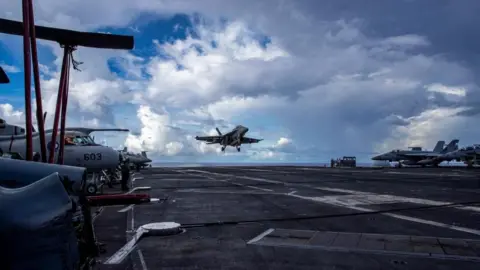
Significant developments include the arrival of a US carrier strike group, the USS Abraham Lincoln, with its complement of advanced F35 stealth jets and destroyers armed with Tomahawk missiles.
Matthew Savill, director of military sciences at RUSI, stated that with their current military posture, the US could probably go almost anywhere in Iran and strike almost anything, apart from the most deeply buried facilities.
President Trump appears torn between demonstrating military strength and avoiding a prolonged conflict, having advocated for potential diplomatic resolutions.
As the situation evolves, the global community watches closely, weighing the implications of renewed military action in a historically volatile region.