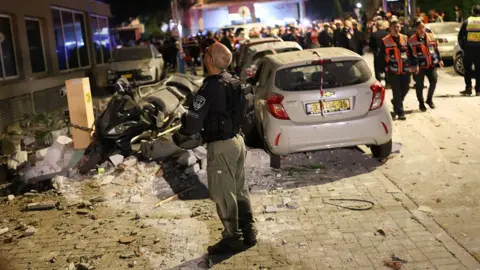
It was late at night when an Iranian cluster bomb flew through the ceiling of an elderly couple's apartment in central Israel and exploded in their tiny living room, killing them both. The path of the bomb was still clearly mapped onto the ash-covered debris left behind. A large hole in the ceiling marked where it punched through, forcing broken concrete and metal rods inwards. Shrapnel holes across the back walls showed the force of the explosion, which destroyed the front of the apartment—leaving it open to the street outside.
Inside, a walking frame lay upended on the floor under the ash-covered furniture and rubble. We heard three noisy interceptions, but on the fourth one, we knew it was our house, said Sigal Amir, a neighbor who was sheltering in her safe room when the explosion hit. There was a massive boom and I felt a pain in my ear from the blast, she said. The neighbors, just five meters away, had their door blown off and their house filled with dust like snow.
Iranian missile strikes have become a growing threat, especially given the increased use of cluster bombs, which scatter munitions across a wider area, making them significantly harder to defend against, even when the missile carrying them is intercepted.
The casualties from these strikes have generally been low, but the latest incident starkly illustrates the risks faced by civilians. To be honest, in the last days I'm losing hope a little bit, Sigal expressed, feeling uncertainty about the end of the violence. As hostilities continue and military responses intensify, the resilience of the Israeli population is being tested amid constant alarms and fears of future attacks.
Inside, a walking frame lay upended on the floor under the ash-covered furniture and rubble. We heard three noisy interceptions, but on the fourth one, we knew it was our house, said Sigal Amir, a neighbor who was sheltering in her safe room when the explosion hit. There was a massive boom and I felt a pain in my ear from the blast, she said. The neighbors, just five meters away, had their door blown off and their house filled with dust like snow.
Iranian missile strikes have become a growing threat, especially given the increased use of cluster bombs, which scatter munitions across a wider area, making them significantly harder to defend against, even when the missile carrying them is intercepted.
The casualties from these strikes have generally been low, but the latest incident starkly illustrates the risks faced by civilians. To be honest, in the last days I'm losing hope a little bit, Sigal expressed, feeling uncertainty about the end of the violence. As hostilities continue and military responses intensify, the resilience of the Israeli population is being tested amid constant alarms and fears of future attacks.