In brief
Volunteers in Washington D.C. are using cutting-edge monitoring tools to detect methane leaks in their neighborhoods, contributing to a vital effort in environmental health and climate change awareness.
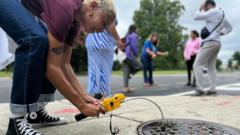
The issue of methane detection is increasingly urgent in today's world, where community members and activists are taking an active role in monitoring air quality, particularly around Washington, D.C. Equipped with handheld devices that resemble walkie-talkies, volunteers are walking through neighborhoods to assess the presence of methane and other hazardous gases in the air. These specialized monitors provide detailed readings on methane levels, unveiling troubling statistics. In just 25 hours, researchers documented 13 outdoor methane leaks that surpassed the lower explosive limits, alarming not just for safety, but also for public health implications—particularly concerning the staggering rate of asthma among children in the affected areas. Djamila Bah, a healthcare worker and community leader, noted that one-third of children tested are asthmatic, highlighting the severe impact these leaks can have on health.While methane poses dire health risks, it also plays a significant role in climate change, being a potent greenhouse gas that contributes roughly 25% to the global temperature rise since the onset of industrialization. Major sources of emissions are diverse and encompass fossil fuels, agriculture, and waste management sectors. Detecting methane can be a challenge as the gas is largely invisible; however, advances in handheld sensors and infrared cameras provide much-needed visibility, allowing for both ground-based and aerial assessments.The growing affordability and effectiveness of these sensors mean that monitoring methane emissions is now more feasible than ever—yet, as Andreea Calcan of the International Methane Emissions Observatory points out, there is still a need for comprehensive strategies that address leak detections of both small and large magnitude.On a larger scale, satellites such as the recently launched Tanager-1, created through collaborative efforts involving Carbon Mapper and NASA, are set to revolutionize methane emissions tracking. These satellites can identify major emission events while also honing in on smaller, discreet sources, offering enhanced resolution in understanding emissions sources.Despite these technological advancements, challenges remain—certain environments obscure satellite detection capabilities. However, Carbon Mapper aims to overcome such barriers with high-resolution tools that allow for more precise action, particularly in identifying responsibility for emissions in densely packed areas such as oil and gas fields.Increasing data accessibility is crucial, given the continuous rise in methane levels even as detection capabilities improve. Initiatives like the Methane Alert and Response System (MARS) use satellite data to monitor emissions, employing machine learning to enhance plume recognition. Yet, only 1% of alerts have prompted action thus far, emphasizing the necessity for improved communication and response systems.Local initiatives in areas like Washington, D.C., are empowering residents to take charge of air quality and challenge misinformation regarding health impacts. Joelle Novey from Interfaith Power and Light echoes a sentiment of optimism, claiming, "Now that we know better, we can do better," emphasizing a hopeful shift toward greater environmental stewardship driven by informed community action.