In brief
Russian scientists have unveiled an intact 50,000-year-old baby mammoth named Yana, found in Siberian permafrost. This discovery showcases the impact of climate change on ancient remains and adds to recent finds of prehistoric creatures in the region.
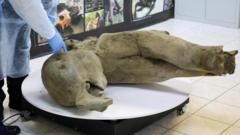
In a groundbreaking discovery, Russian scientists have showcased the remains of Yana, a 50,000-year-old baby mammoth unearthed from thawing permafrost in Siberia's remote Yakutia region during the summer months. Weighing over 100 kg (15 st 10 lb), measuring 120 cm (4 ft) tall and 200 cm long, Yana is estimated to have been only about one year old at the time of her demise.This remains one of the best-preserved mammoth carcasses ever found, with only six similar discoveries historically recorded worldwide—five in Russia and one in Canada. Yana was located in the Batagaika crater, known as the world's largest permafrost crater, by local residents who fortuitously discovered her partially exposed remains.Maxim Cherpasov, head of the Lazarev Mammoth Museum Laboratory, recounted that upon seeing the mammoth had nearly thawed out, the residents created a makeshift stretcher to lift her from the frozen ground. Although some parts like the forelimbs had already been consumed by wildlife, the head remains remarkably intact.Gavril Novgorodov, a researcher at the museum, suggested that Yana likely became trapped in a swamp, leading to her preservation for millennia. Currently, Yana is undergoing further studies at the North-Eastern Federal University in Yakutsk, where scientists aim to determine the precise timing of her death.This remarkable discovery is not isolated; the thawing permafrost continues to reveal ancient remains in Russia. Just last month, researchers presented the partial mummified body of a sabre-tooth cat, believed to be nearly 32,000 years old, while a 44,000-year-old wolf was found earlier in the same year. Such finds emphasize the significant paleontological implications as climate change reshapes the frozen landscapes of Siberia.