In brief
The evolving technological landscape of military engagement has introduced drones as new players in the long-standing rivalry between India and Pakistan.
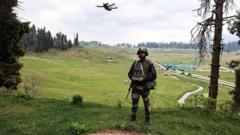
In a historic confrontation marking the first drone war between nuclear-armed India and Pakistan, both nations have exchanged accusations of drone and missile attacks along their contentious border. On Thursday, India alleged that Pakistan launched a series of drone operations at several military bases in Indian-administered Kashmir. Pakistan promptly rebuked these claims, asserting that its forces intercepted 25 Indian drones in various cities, including major urban centers like Karachi and Lahore.Analysts suggest that these unprecedented exchanges symbolize a perilous new reality in the ongoing conflict. With both countries reliant on unmanned aerial vehicles (UAVs) for military action, the dynamics of confrontation have shifted significantly. Experts warn that drones, characterized by their stealth and precision, have transformed how these two countries engage, introducing risks of escalation that could affect the entire region.The exchanges have resulted in significant casualties; reports indicate at least 36 fatalities and numerous injuries in Pakistan due to Indian air strikes, while India's military cites 16 civilian deaths from Pakistani bombardments. India’s recent missile strikes were presented as a response to a militant attack on Indian tourists, an incident Pakistan vehemently denies being involved in.Reports suggest that both nations are equipped with advanced drones, with India’s UAV arsenal prominently featuring Israeli models like the IAI Searcher and Harop, which are utilized for reconnaissance and strikes. Meanwhile, Pakistan deploys a mix of domestically-produced and international drones, with a noted focus on integrating advanced technologies to enhance its military capabilities.Despite the tactical impact of drones on the battlefield, experts argue that their role in this specific conflict remains limited compared to their utilization in other global conflicts, such as the ongoing war between Ukraine and Russia. Here, drones play a central role in diverse military operations, while, in India and Pakistan’s case, traditional air forces continue to dominate operations.Looking toward the future, analysts express that the current drone tactics might just be a precursor to more significant military engagement. The use of UAVs opens pathways for retaliation and preemptive strikes; however, each engagement also carries the risk of triggering broader conflicts that both nations seem keen to avoid.With the situation unfolding, the international community is closely monitoring developments as both India and Pakistan navigate this uncharted territory. The integration of drones into their military operations could redefine the nature of conflict in South Asia, posing new challenges for regional stability and security.