In brief
At a summit hosted by President Trump, the leaders of the Democratic Republic of Congo and Rwanda are expected to sign a peace deal aimed at ending a prolonged conflict exacerbated by accusations of rebel support and escalating violence. Despite hopeful rhetoric, skepticism remains about the deal's potential to achieve lasting peace amid ongoing tensions and military actions.
The leaders of the Democratic Republic of Congo and Rwanda are set to sign a peace deal aimed at ending the long-running conflict in the region at a summit hosted by US President Donald Trump in Washington.
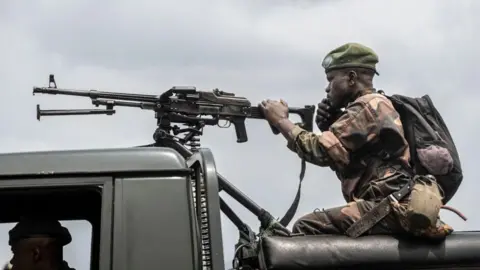
Ahead of the summit, there has been an escalation in fighting in resource-rich eastern DR Congo between government forces and rebels believed to be backed by Rwanda.
DR Congo's army accused its rivals of attempting to sabotage the peace process, but the M23 rebels said the army had launched an offensive in breach of a ceasefire.
At the start of the year, the M23 seized large parts of eastern DR Congo in an offensive that saw thousands killed and many more forced from their homes.
DR Congo's President Felix Tshisekedi and his Rwandan counterpart Paul Kagame have frequently exchanged insults in recent years, each accusing the other of starting the conflict.
Trump got the two countries' foreign ministers to sign a peace accord in June, hailing it as a glorious triumph.
Tshisekedi and Kagame will now endorse it, with several other African and Arab leaders - including those of Burundi and Qatar - expected to attend the signing ceremony.
Despite the fanfare and the presence of the two leaders in Washington, some analysts are skeptical about whether the deal will lead to lasting peace.
A DR Congo researcher with the South Africa-based Institute for Security Studies think-tank, Bram Verelst, told the BBC that there was currently no ceasefire in place, and the M23 rebellion continues to expand and consolidate its control.
Rwanda denies supporting the M23, despite UN experts saying its army is in de facto control of M23 operations.
The deal to be signed demands both sides halt hostilities and outlines conditions for peace, but previous agreements have failed over similar issues. The peace signing is seen as a pivotal moment, but the reality on the ground raises doubts regarding its effectiveness.