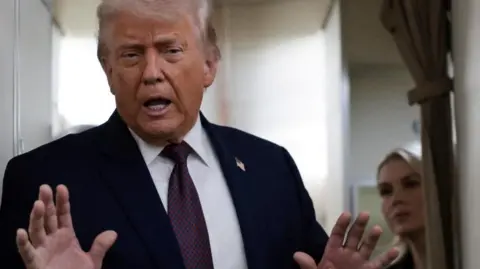
The Trump administration has quickly abandoned its familiar deny and attack playbook after initially using it when federal agents shot dead Alex Pretti in Minneapolis on Saturday morning.
Within 24 hours, as various videos of the shooting circulated online, it became clear that the White House was out of step with public opinion.
Since then, the administration – and the president himself - have changed tack, blaming Democrats for what happened and focusing less on the actions of the American nurse who was killed.
Democrats, meanwhile, have increased their criticism of the president's mass deportation policy and the aggressive tactics of Immigration and Customs Enforcement (ICE), leaning into a political fight that could result in a new government shutdown on Friday.
On Monday morning, Deputy Attorney General Todd Blanche described the situation as a powder keg. While he blamed the Democrats, many on both sides of America's political divide will agree that the current situation is fraught with peril.
The initial administration response to Pretti's death was straightforward. The 37-year-old was portrayed as a domestic terrorist bent on bloodshed.
Homeland Security Secretary Kristi Noem said that Pretti wished to inflict harm and was brandishing a weapon. US Border Patrol Commander Gregory Bovino said it looks like a situation where an individual wanted to do maximum damage and massacre law enforcement.
This White House has typically been quick to push back when criticized. Deny and attack has long been a bedrock Trump strategy for handling adversity.
But, perhaps tellingly, White House Press Secretary Karoline Leavitt refused to echo Miller's comments herself on Monday when pressed on whether the president agreed with his senior adviser. Instead, she said a full investigation would be carried out.
It was a notably more muted tone than that struck immediately after the shooting.
That initial response had echoed the path the administration took three weeks ago, when federal law enforcement shot and killed another Minneapolis resident, Renee Good. They said Good was a terrorist who had weaponised her vehicle in an attempt to injure ICE agents.
As with Good's case, the federal government's version of events has been challenged by local officials, eyewitnesses, and the victim's family. In a statement on Sunday, Pretti's parents asked for the truth to come out, adding: The sickening lies told about our son by the administration are reprehensible and disgusting.
Multiple videos of the deadly encounter contradict many of the administration's initial claims. The footage shows Pretti filming ICE agents with his mobile phone and helping a woman who is pushed over before both are pepper-sprayed. Pretti is visibly not holding a gun when he is wrestled to the ground.
DHS says Pretti had a 9mm semi-automatic handgun and two magazines of ammunition. Local police have said Pretti was a legal gun owner. Under Minnesota law, citizens can legally carry a concealed handgun in public if they have a permit.
This time around, the administration's initial response quickly became difficult for the administration to maintain. People have had enough, Minneapolis Police Brian O'Hara said, noting that his officers made hundreds of arrests of violent offenders last year without resorting to shooting. This is not sustainable.
Republicans in Washington DC and elsewhere have expressed growing unease with how the administration was handling the situation. Vermont Governor Phil Scott called the federal efforts in Minnesota a complete failure of coordination of acceptable public safety and law enforcement practices, training, and leadership – at best.
At worst, he said, it was deliberate federal intimidation and incitement of American citizens.
In Congress, some Republicans expressed unease with the White House actions and called for new oversight.
Since Sunday night, there has been a marked change in tone from the White House. Veteran's Affairs Secretary Doug Collins offered condolences to the Pretti family, while the president posted a message on Truth Social calling the death tragic and blaming it on Democrat ensued chaos – a message echoed by Vice-President JD Vance.
Trump's dispatch of border czar Tom Homan to Minnesota to direct law enforcement efforts signals a facade of cooperation, though concerns about the administration's harsh immigration policies persist.
Amid the increasing scrutiny, both Trump and state leaders have shown potential signs of opening dialogue, leading to speculation about lasting changes regarding immigration practices.
As both parties contend with the public fallout of this tragic incident, the implications of immigration enforcement remain ever critical to national discourse.