In brief
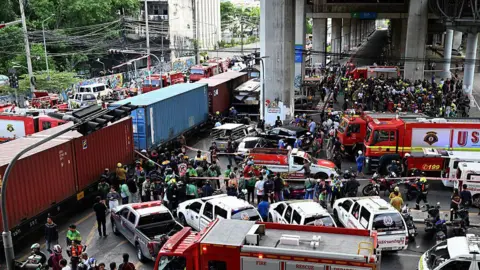
In a tragic incident at the Asoke-Din Daeng railway crossing in Bangkok, a freight train collided with a public bus, leading to eight confirmed deaths and numerous injuries. Authorities reported that the train driver tested positive for drugs and has been charged with reckless driving. The bus reportedly became stuck on the tracks due to heavy traffic, preventing safety barriers from functioning properly. Other involved parties, including the bus driver and the barrier guard, face charges as well. The accident has raised concerns over safety at this notoriously busy crossing, where traffic congestion often leads to risky behavior by motorists.
The driver of a freight train involved in a fatal collision with a public bus in Bangkok has tested positive for drugs and been charged with reckless driving, authorities say. The collision, which happened at the Asoke-Din Daeng railway crossing on Saturday afternoon, saw the train crash into a public bus that had come to a stop on the railway tracks.The bus burst into flames, killing eight people and injuring dozens. Initial reports suggest the bus had become stuck on the tracks due to heavy traffic, which prevented the crossing barriers from lowering properly. The Asoke-Din Daeng railway crossing is notoriously hectic, leading to one of the busiest intersections in Bangkok.Both the bus driver and the guard responsible for lowering the barrier - which is done manually - have also been charged, police said. Authorities have ordered mandatory drug and alcohol tests for all train drivers and railway staff before their shifts, said Pichet Kunadhamraks, director-general of Thailand's rail transport department. Police did not specify what drugs had been found in the urine test of the train driver.Pichet stated that preliminary findings from the train's black box showed its emergency braking system was only activated about 100m (330ft) away from the bus, which was not sufficient to avoid a collision. Dr Amorn Phimarnmas, president of the Structural Engineers Association of Thailand, estimated that more than 100,000 road vehicles pass through the Asoke-Din Daeng railway crossing daily, exceeding the safety threshold for such crossings.At the crossing, motorcyclists often weave through safety barriers to beat traffic and avoid being delayed by passing trains. The tracks were built long before the surrounding roads, and the city has grown around them, leading to what experts describe as risk normalization – where risks become routine and people disregard them until a disaster occurs. Dr. Amorn emphasized, It's when risk becomes routine. People think 'it'll be fine' and carry on, until one day we end up with exactly the kind of disaster we've just seen.\