In brief
This winter is proving to be one of the toughest for Ukraine as central heating infrastructure, a legacy of Soviet urban planning, is severely targeted by Russia. With record low temperatures and continual bombings, thousands of apartment blocks in Kyiv have gone without heating, pushing residents to the brink of desperation. Experts warn that the centralized heating system's vulnerabilities have been exposed during the conflict, leading to a humanitarian crisis as the government seeks urgent reforms to mitigate these issues.
Ukraine is now living through its most difficult winter in recent memory. With January temperatures plummeting below -15C, Russia has been attacking energy infrastructure, leaving about a million Ukrainians without heating.
The capital, Kyiv, is the main target of such attacks. Following the latest Russian bombardment overnight into January 24, almost 6,000 apartment blocks were left without heating, according to mayor Vitaly Klitschko. This is the third such Russian attack targeting Kyiv's heating infrastructure in little more than two weeks, after strikes on January 9 and 20 also left hundreds of thousands freezing in their flats.
Living in Kyiv is a bit of a gamble these days, one resident of the Ukrainian capital, Rita, told the BBC. If you have heating and gas, there is no electricity and water. If you have electricity and water, there is no heating. Coming home is like playing a guessing game every day - will I be able to shower or have hot tea, or neither? And of course missiles and drones come on top of all that. She says she has to go to bed wearing a hat and several layers of clothing.
What is making things much worse for Ukraine and easier for Russia is the widespread prevalence of apartment blocks that rely on communal central heating - where water is heated up elsewhere and then pumped into their radiators. Heating plants in Ukraine are huge and many thousands of people are affected when they are targeted by Russian forces. Ukraine says that all such power plants have now been hit.
Such attacks also disrupt electricity supplies, but while a generator or battery pack might help in this situation, heating is less straightforward - especially when there is also no electricity to power your heater. Kyivteploenergo, the monopoly supplying heating and hot water in the Ukrainian capital, stated that the absolute majority of houses in Kyiv rely on its services. It said it could not share the exact number for security reasons.
In Zaporizhzhia, a frontline city home to 750,000 people, almost three-quarters of residents rely on central heating, according to Maksym Rohalsky, head of the local association of apartment block dwellers.
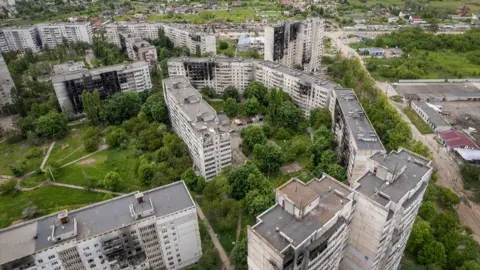
Before Russia's full-scale invasion of 2022, about 11 million households in Ukraine relied on central heating, compared to seven million autonomously heated households, according to Ukrainian energy expert Yuriy Korolchuk. Cities across the Soviet Union, including in Ukraine, underwent massive construction programs launched in the 1950s to mass produce cheap housing.
The landscapes of cities in the former USSR are dominated by ubiquitous nine-storey residential buildings made from pre-fabricated concrete panels, known as panelki, or smaller five-storey blocks of flats known as khrushchevki, after Soviet leader Nikita Khrushchev, who oversaw their construction in the 1950s and 1960s.
Heating to such houses is supplied by large plants known as TETs - an acronym that stands for heat and electricity centrals in Ukrainian as they generate electricity as well as heat. Detached houses occupied by a single family, commonly referred to as private houses in Ukraine, are normally found in rural areas and are rare in cities.
Ukraine inherited the Soviet heating system and it hasn't changed much; it remains predominantly centralized. These heating plants were not designed to be attacked with missiles or drones, that's why these vulnerabilities came to the fore during the war, Korolchuk explained. He noted this is a new tactic being used by Russia, with strikes against the heating system that were uncommon previously.
Referring to ongoing talks to end the war, he suggested that the strain on heating resources may serve as pressure in negotiations. This wartime tactic exploits the efficiencies of scale in centralized installations, but when they are targeted, the consequences can be catastrophic for large populations.
The Ukrainian government is aware of these vulnerabilities and is considering reforms to implement individual heating points at apartment blocks. However, transforming decades of Soviet urban planning will not be a quick or easy task.