In brief
The United States has announced a major shift in its foreign policy towards three West African nations that have seen military coups and are now aligning more closely with Russia for defense. This marks a significant change as the Biden administration intends to respect the sovereignty of Mali, Niger, and Burkina Faso while prioritizing security cooperation over democracy and human rights. With growing jihadist threats in the Sahel, the US aims to counterbalance Russia's presence, which has taken root through military contractors in the region.
The US has declared a stark policy shift towards three West African countries which are battling Islamist insurgents and whose military governments have broken defense ties with France and turned towards Russia.
The state department announced that Nick Checker, head of its Bureau of African Affairs, would visit Mali's capital Bamako to convey the United States' 'respect for Mali's sovereignty' and chart a 'new course' in relations, moving 'past policy missteps'.
It adds that the US also looks forward to cooperating with Mali's allies, neighboring Burkina Faso and Niger, 'on shared security and economic interests'.
Absent from the agenda is the longstanding American concern for democracy and human rights. The Biden administration had halted military cooperation after coups deposed the elected civilian presidents of all three countries between 2020 and 2023, with Niger's Mohamed Bazoum still locked up in his own residence.
The US statement indicates a radical change in policy that had become increasingly evident over the past year. The shift started with the shuttering of USAID – a key provider of development support to the region – just days after President Trump was sworn in for a new term.
This was followed by repeated signals of a much narrower focus on security and mineral resources, with both development and governance sidelined.
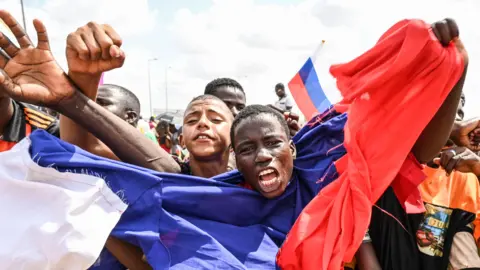
The announcement of Checker's visit goes further in openly declaring respect for Mali's sovereignty. The message will resonate in Bamako and allied capitals, where military leaders have built their appeal by striking pan-Africanist themes and rejecting former colonial power France.
Burkina Faso's military leader, Capt Ibrahim Traoré, presents himself as a standard-bearer in resisting 'imperialism' and 'neo-colonialism'. Through vigorous social media promotion, he has gained significant support for this stance and personal popularity among young people across the continent and beyond.
The Trump administration has made clear that it is unconcerned by the regimes' rejection of the European-style constitutional model of elected civilian government. Massad Boulos, senior adviser for Africa at the state department and a Trump confidant, said last year: 'Democracy is always appreciated, but our policy is not to interfere in the internal affairs of other countries. People are free to choose whatever system is appropriate for them.'
This indicates a notable policy shift. During the Biden era, Gen Michael Langley, head of the US military's Africa Command (Africom) from 2022 to 2025, stressed the importance of good governance and environmental issues, as complements to military support.
Yet, after Trump returned to the presidency, the focus shifted almost exclusively to supporting the fight against terrorism as a primary concern. This was reiterated by Rudolph Attalah, a senior counter-terrorism official, during a visit to Bamako last year.
Following a series of military coups, Niger, Burkina Faso, and Mali withdrew from the ECOWAS regional bloc and are now focused on forming their confederation, the Alliance of Sahel States (AES). The crunch in security, particularly with jihadist groups encroaching into neighboring countries, is creating an urgent need for US support in tackling these groups.
However, despite the urgent requirement for security, it is reiterated that high-tech military solutions alone cannot reinstate peace without addressing the complex socio-economic issues affecting the poorest regions in the world.