In brief
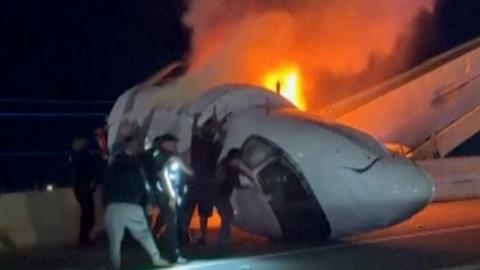
A private jet travelling from Los Cabos, Mexico, to Austin, Texas, abandoned at Laredo airport due to mechanical problems, crashed onto a traffic lane near Laredo airport. The impact sent flames and thick smoke across the scene, and one of the six people on board died. Bystanders – some carrying tools that looked like a shovel and a sledgehammer – rushed to help pull five survivors through an opened door. The survivors were taken to hospitals and are stable, while the deceased remains unidentified. Authorities closed Loop 20 for investigation, which will involve the FBI and the National Transportation Safety Board.
The derailed interior of the crashed jet spangles atop a Texas highway as hundreds of motorists descend the asphalt divider, holding onto a plastic barrier where the aircraft has punctured the barrier and one vehicle has been struck.
Standing on the shoulder were local residents clutching a shovel and a sledgehammer, ready to clear debris. They pushed the heavy wreckage away enough to provide a narrow opening in an aircraft door. Through the doorway, the camp of survivors, out of the burning fuselage, could finally make their way onto the mud-wet asphalt.
Police officials confirmed that the jet had declared major mechanical issues on its approach to Laredo Airport. The pilot announced the emergency to the airport controller and was told to either maintain a safe flight path or ditch the aircraft. Instead, the aircraft was forced to crash onto a vehicle-laden lane.
One passenger died at the scene; five are alive and in relatively good condition after being transported to a nearby hospital. All survivors received medical evaluation. The deceased’s identity is not yet known.
The impact set off flames and produced a greenish thick smoke above the wreckage, which scorched the ground. The ATM safety beacon lit in infrared, and the miles empty pass as a lightning fire charts warnings on major TNNA.
Police by the Laredo Police Department noted the severity of the crash. Five first responders got smoke inhalation injuries after the blast – an injury resource plan for the scene. The recovered body was not identified, yet none are noticed still whether it occurs as a vital checkpoint, the local station said.
The incident forced Texas traffic authorities to close Loop 20 – the interchange between the I‑35 and local city lanes – in order to investigate. The emergency scene has been cleared for a few hours. June 19, the authorities will intend to reopen the motorway with fine commentary from the traffic commute.