In brief
Despite recent territorial losses to Syrian government forces, Kurdish fighters, led by Commander Azad, express unwavering resolve to continue their struggle for autonomy in northeastern Syria. With a history of joint efforts against ISIS now tarnished by perceived betrayal from the United States, the Kurds face renewed challenges as the ceasefire with the government nears expiration. The ongoing conflict holds implications beyond the battlefield, particularly regarding the handling of thousands of captured ISIS fighters and their families. Kurdish leaders emphasize their commitment to protect their region against any further government encroachment.
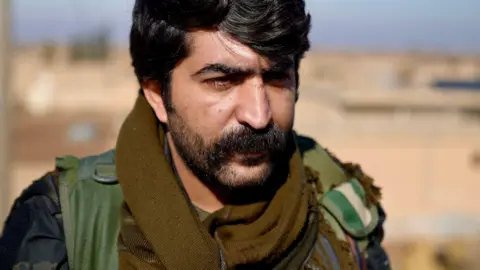
As a veteran Syrian Kurdish fighter, Commander Azad – whose nom-de-guerre means freedom - walks with a limp and wears his battle scars with pride. 'My leg was injured when we were bombed by a Turkish warplane in 2018,' he says. 'And this was shrapnel from a suicide bomber,' he adds, rolling up his sleeve to reveal a deep gouge in his arm. 'My back, abdomen and lower body were all injured in four separate attacks by Daesh,' he says, using the Arabic acronym for the Islamic State group (IS).His latest wound is below the surface, and cuts deep – what he sees as betrayal by a former friend, the United States. After IS seized around a third of Syria and Iraq in 2014, the US and the Kurds worked hand in glove to drive them out. Not anymore.'History will hold them accountable,' says the commander, who has a handle-bar moustache and wears a green fringed scarf around his neck. 'Morally it's not right. But we will keep fighting until our last breath. We are not cry-babies.'Their current fight is with the central government in Damascus which wants to extend its control across all of Syria, including the Kurdish autonomous region in the north-east.In the past two weeks government troops have pushed the Kurdish-led Syrian Democratic Forces (SDF) out of resource-rich areas they have controlled for a decade – since defeating IS.As conflict has flared, the White House has strongly backed Syria's interim president, Ahmed al-Sharaa - a former Jihadi. That's a slap in the face for the Kurds. The SDF lost 11,000 fighters battling the jihadis of IS.Commander Azad compares the president to Abu Bakr al-Baghdadi, the late founder of IS. 'They are the same thing. After Jolani took over, Syria will always be a war zone,' he says.Having fought US troops in Iraq, Al Sharaa set up an al-Qaeda offshoot in Syria, which was in fact fiercely opposed to IS though the groups had similar roots. He later broke with al-Qaeda, then in December 2024 swept to power in Damascus, ousting Bashar al Assad.In the eyes of the Kurds, Al Sharaa is still a Jihadi, but now in a suit.Commander Azad stiffly climbs the stairs to an open rooftop with a commanding view of flat countryside. Below us sheep graze in the fields and clothes flaps on a washing line in a back garden. But a pick-up truck with an anti-aircraft machine gun is parked outside the door, and there is a cluster of troops in camouflage uniforms. This is the SDF's last checkpoint in their stronghold of Hassakeh province. 'They [Syrian government forces] are in an Arab village seven kilometres from here,' he says, gesturing to the horizon. 'So far, there is no danger. I hope there will be no war, but if it comes, 'Let it be welcome,' he says, quoting Che Guevara, Cuba's revolutionary hero.'We are focusing all our efforts on reaching a permanent ceasefire or a lengthy one,' says Siyamend Ali, of the People's Protection Units (YPG), a Kurdish militia that is the backbone of the SDF. 'We don't want war, but if we are forced down that path we will fight back. Every neighbourhood will turn into a hell for them.'The Syrian government has taken control of one camp, al-Hol, in eastern Hassakeh. When we visited last October - with an armed escort - we got a hostile reception from veiled women, clad head to toe in black. One ran a finger across her neck, as if slitting a throat.The other main camp, called Roj remains in Kurdish hands. It's home to more than 2,000 foreign women and children, who have been convicted of nothing. Rows of blue and white tents offer little protection from biting winter cold.But in the camp's cheerless food market we met women who pointed out that their children are guilty of nothing and pleaded for them to have a normal life. We spoke to two women from North Africa, who did not want to be identified. 'I want to leave this place,' one woman said, 'so my daughter can study and live her life. She has the right to an education, to visit a park, to get medical care.' As the sands shift in Syria countries that have been willing to leave their citizens in Kurdish camps indefinitely may have to think again – the UK included.