Hind Kabawat: Syria's Trailblazing Woman Minister Challenges the Status Quo
On the first day, I asked 'why are there no more women? says Hind Kabawat, the only female minister in Syria's transitional government, as she advocates for women's representation during a critical time for the country.
Syria has been on a tumultuous journey from war to peace, and Kabawat's role as the Minister for Social Affairs and Labor places her at the forefront of this transformation. The country is grappling with severe sectarian violence, resulting in significant loss of life and deep societal divisions. Despite these challenges, Kabawat remains resolute, asserting that mistakes are a part of any transition.
She reflects on her past as an opposition leader in exile and acknowledges government errors since President Ahmed al-Sharaa's forces took control in December 2024. Despite being the only woman in a male-dominated cabinet, Kabawat emphasizes the need for change, citing the importance of appointing more women to leadership roles.
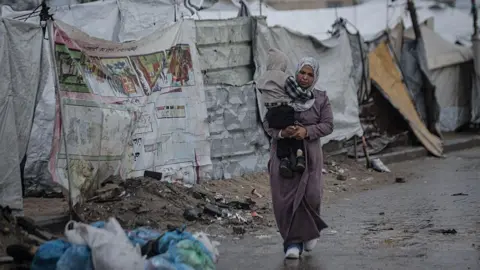
In her efforts to address the needs of the vulnerable populations, such as orphans, widows, and displaced families, Kabawat has visited camps and shelters throughout the conflict-stricken regions, taking a proactive stance in fostering community support and integration.
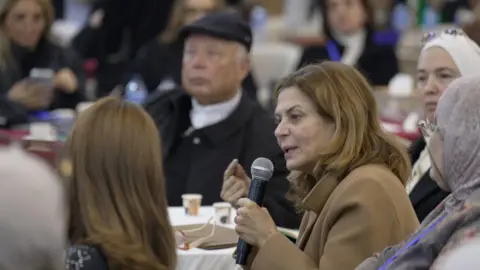
During a recent visit to a refugee camp in Aleppo, she listened to the local women's concerns and offered to provide skills training to enhance their employability. She underlines the urgency of creating jobs for those displaced by nearly 14 years of conflict and stresses that 90% of Syrians now live under the poverty line.
Despite her determination, Kabawat's advocacy for women is not without its challenges. In a conference in Idlib, she chastised a group of women for their lack of political strategy in recent elections, where only 4% of seats were awarded to female candidates. She encourages them to unite and promote women effectively in future elections.
Though Kabawat faces hurdles in mending the fractures within diverse Syrian communities, she is committed to fostering dialogue and building trust in government. She reminds that trust must be cultivated people to people as well as between the government and the populace.
As the country remains unstable amidst external threats, including Israel's military actions against perceived dangers, Kabawat's call for inclusivity and responsibility within the government serves as a beacon of hope for women and Syrians alike, far removed from tokenism. I'm not here for window dressing, she asserts, embodying her vision for a stronger, united Syria that prioritizes gender equity in governance.