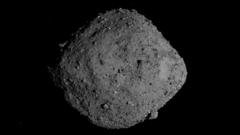
Researchers have unveiled that asteroid Bennu, a colossal 500-meter-wide accumulation of rocks and debris, holds significant findings regarding the fundamental components of life. Samples from this celestial body, collected by NASA’s Osiris Rex mission and returned to Earth, exhibit a plethora of essential minerals and diverse organic compounds, including amino acids and nucleobases - the core elements of proteins and DNA, respectively.
Although the presence of these compounds on Bennu does not imply that life ever existed there, it lends credence to the theory that such vital ingredients may have arrived on Earth through asteroid impacts billions of years ago. Prof Sara Russell, a cosmic mineralogist at the Natural History Museum in London, emphasized the implications of this research. "It’s telling us about our own origins, and enables us to address significant questions about the genesis of life," she stated.
The research has been documented in two papers published in the journal Nature. NASA's bold mission involving the Osiris Rex spacecraft involved a meticulous process of utilizing a robotic arm to gather samples from the asteroid's surface and returning approximately 120 grams of material to scientists worldwide, despite the seemingly small amount.
The analysis revealed that the samples are rich in nitrogen and carbon-based compounds. Notably, they contain 14 of the 20 amino acids recognized as building blocks of life on Earth, along with all four nucleobases critical for DNA formation. Furthermore, the discovery of minerals and salts suggests that water may have once existed on Bennu, and ammonia was also present, an essential component for various biochemical reactions.
While similar compounds have previously been observed in meteorites, many of the findings from Bennu samples are unprecedented. Prof Russell remarked on the unprecedented richness of the samples, stating, "It’s full of minerals we haven't seen before in meteorites and the unique combinations want incredible."
The new insights bolster the theory that asteroids were instrumental in delivering water and organic materials crucial for Earth's development. As Dr. Ashley King from the Natural History Museum articulated, the early Solar System brimmed with asteroids like Bennu that potentially bombarded Earth, contributing to the creation of oceans and life.
The research also raises the question of whether other celestial bodies may similarly have exchanged their primordial ingredients with life-sustaining elements. With Earth being the only known planet to harbor life, the ongoing investigation into these celestial phenomena may help unlock the enigmatic conditions under which life could exist elsewhere in the Solar System.
The research community has a long roadmap ahead as they continue to analyze the cosmic dust from Bennu and explore more of our celestial neighborhood for insights into the origins of life.