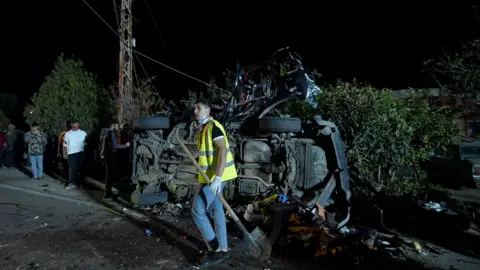
Last Friday, at around 19:00, an Israeli air strike hit a car in a village in southern Lebanon called Froun. This part of the country, the heartland of the Shia Muslim community, has long been under the influence of Hezbollah, the Lebanese Shia militia and political party. Streets are decorated with banners of fighters who died in battle, hailed as 'martyrs of the resistance'. After the strike, I arrived in Froun to witness the aftermath, where rescue workers had already removed the body parts of a casualty described by the Israeli military as a 'Hezbollah terrorist'.
Despite a ceasefire agreement enacted last November, Israeli airstrikes continue almost daily. Mohamad Mokdad, a resident of Froun, expressed his despair, asking, Who is going to help us? as he cleaned up the debris from his home. He lamented that all he desires is a peaceful life, revealing the growing frustration among the people.
Israel claims these attacks target Hezbollah, attempting to thwart the group's recovery following its severe damage during the prolonged war. However, many in Lebanon, traditionally aligned with Hezbollah, are beginning to question the group's role and its impact on their lives. The initial conflict ignited after Hezbollah retaliated with rocket fire in response to Israel's military actions in Gaza following the Hamas-led attacks on October 7, 2023.
The truce established conditions for both sides, including a withdrawal of Hezbollah from the south of the Litani River and an Israeli retreat from Lebanese territory. However, Israeli air and drone operations persist, further escalating tensions. UNIFIL, the United Nations peacekeeping force in Lebanon, noted over 10,000 violations by Israel, leading to significant civilian casualties, with reports of over 330 deaths since the ceasefire.
Critics of Hezbollah, disillusioned by the prospect of ongoing hostilities, are becoming increasingly vocal. In the village of Beit Lif, residents publicly appealed for Saudi-backed Lebanese military support amid fears of imminent Israeli attacks. A local imam shared his concerns, stating, Hezbollah needs to decide: it either responds to Israel or accepts defeat. This can't continue.
Amid this climate of insecurity, Nayef al-Rida, a resident of the border town of Yaroun, expressed his fear of living under constant surveillance by Israeli drones. With the realization that many in the community are questioning Hezbollah's hold over them, there is an air of confusion and uncertainty. He articulated a common sentiment among residents, stating, This is no life. Their longing for stability clashes sharply against the backdrop of persistent violence.