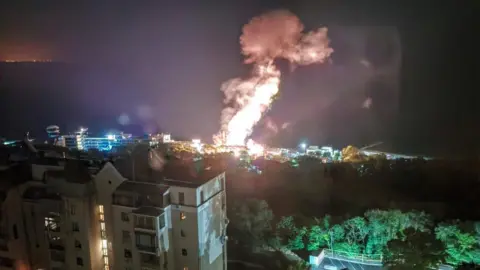
From Mariia's 16th-floor flat, the calm waters of the Black Sea stretch out into the horizon beneath the fading twilight. 'Up here you can see and hear when the drones come,' she says, standing by a wall-length, floor-to-ceiling window. When they hit buildings and homes in the city of Odesa down below 'we see all the fires too'. Her daughter Eva, who is nine, has learned the shapes and sounds of the objects that zoom through the sky on a daily basis. She proudly shows off a list of social media channels she checks when the air raid alerts go off. 'She knows whether what's coming is a risk or a threat, and that calms her down,' her father Sergii says.
There is scarcely a place in Ukraine that has not been targeted since Russia launched its full-scale invasion nearly four years ago. But in recent weeks, Odesa – Ukraine's third largest city – has come under sustained attack. Through strikes on port and energy infrastructure, Russia is trying to cripple the region's economy and dent the population's morale.
Moscow, however, does not just hit facilities. Its drones, mostly as big as a motorcycle, regularly crash into high-rise buildings like Mariia's, exploding on impact and blowing glass and debris inward. The consequences are often deadly. 'A few months ago, Eva said she was afraid the drone would come too fast and we wouldn't have time to hide,' Mariia reflects.
Mariia, Sergii and Eva are originally from Kherson, a region now occupied by Russia. They left as soon as the invasion started in 2022, briefly moving to Germany as refugees. However, the couple reunited in Ukraine and moved to Odesa, where they now contemplate whether they should prepare to leave again as the region intensifies its attacks.
The city marks a month of blackouts and air raid alerts that disrupt everyday life, where daily confrontations with danger and economic pressures have left people weary. The recent surge in air raids is compounded by extreme weather conditions, as many households struggle with power outages that plague the city since December.
As winter temperatures hover around -1C, the supply remains severely disrupted, forcing families like Yana’s to rely on expensive generators. The psychological impact of living under such persistent threat weighs heavily on Odesa’s residents, who grapple with the notion of normalcy amid chaos. As Kostya, a local fisherman, reflects, 'the shelling isn't as scary as this cold is'.
Despite the destruction and ongoing risk of attacks, the residents of Odesa showcase resilience, with local leaders committed to severing ties with Russian influence while defending their homeland. "author": "Laura Gozzi"
There is scarcely a place in Ukraine that has not been targeted since Russia launched its full-scale invasion nearly four years ago. But in recent weeks, Odesa – Ukraine's third largest city – has come under sustained attack. Through strikes on port and energy infrastructure, Russia is trying to cripple the region's economy and dent the population's morale.
Moscow, however, does not just hit facilities. Its drones, mostly as big as a motorcycle, regularly crash into high-rise buildings like Mariia's, exploding on impact and blowing glass and debris inward. The consequences are often deadly. 'A few months ago, Eva said she was afraid the drone would come too fast and we wouldn't have time to hide,' Mariia reflects.
Mariia, Sergii and Eva are originally from Kherson, a region now occupied by Russia. They left as soon as the invasion started in 2022, briefly moving to Germany as refugees. However, the couple reunited in Ukraine and moved to Odesa, where they now contemplate whether they should prepare to leave again as the region intensifies its attacks.
The city marks a month of blackouts and air raid alerts that disrupt everyday life, where daily confrontations with danger and economic pressures have left people weary. The recent surge in air raids is compounded by extreme weather conditions, as many households struggle with power outages that plague the city since December.
As winter temperatures hover around -1C, the supply remains severely disrupted, forcing families like Yana’s to rely on expensive generators. The psychological impact of living under such persistent threat weighs heavily on Odesa’s residents, who grapple with the notion of normalcy amid chaos. As Kostya, a local fisherman, reflects, 'the shelling isn't as scary as this cold is'.
Despite the destruction and ongoing risk of attacks, the residents of Odesa showcase resilience, with local leaders committed to severing ties with Russian influence while defending their homeland. "author": "Laura Gozzi"