David Kuloba's mother warned him about going to Russia after he accepted a job as a security guard advertised by a recruitment agency in Kenya.
At first the family, who live in the Kenyan capital's crowded informal settlement of Kibera had been excited when he said he had found work abroad - it sounded like a rare break.
The 22-year-old had been doing casual labour in Nairobi - from selling groundnuts to construction jobs - and had long hoped to secure work in the Gulf.
But when his mother asked which country he was heading to, his reply shocked her.
He showed me his phone and said: 'Look, it's Russia,' Susan Kuloba told the BBC's Newsday programme.
I told him: 'Don't you see what they show on TV about Russia? It's never good, she recalled.
But her son insisted the offer was genuine, telling her he had been promised more than $7,000 (£5,250) on arrival - a life-changing sum for a young man with no stable income.
Despite her protests, he travelled to Russia in August without telling her the exact date of his departure.
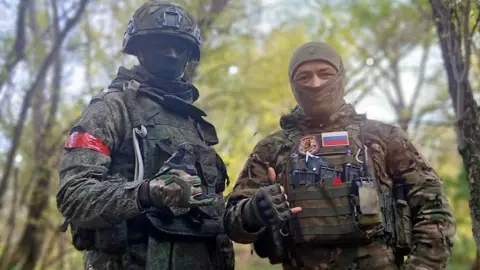
She was shocked when he contacted her later, saying he had arrived and sending a photograph of himself in full combat uniform.
He told me: 'Mum, the job we were told we came to do has been changed, but even this one is not bad,' she said.
Her son explained that he and some other Kenyan men had been given two weeks of combat training - and he was heading to the battle zone in Ukraine, which Russia invaded in 2022.
Within days, he told her that he and others had been ambushed in an area controlled by Russian forces. She pleaded with him to come home.
I said: 'David, please leave that place.' He told me: 'How can I leave? I signed a contract. Give me at least one year.'
Then she received the message she feared.
It was 4 October. David had sent her a voice note saying he was about to go into battle and in case he did not survive, he wanted her to have details of his Russian military ID and contract, which was written in Russian.
He urged her to take the documents to the Russian embassy if anything happened to him.
That was the last time she heard from him.
Confused and terrified, she sought help not long after from her son's friend, who told her that he had heard David was dead.
I asked his friend: 'How do you know?' He said: 'Let me give you the number of the agent who received us in Russia.'
Mrs. Kuloba messaged the number - the replies came in Russian at first. When she identified herself, the person told her in English that David was missing, feared dead.
I'm sorry to tell you this about your son, the agent said.
She asked for a picture of his body, or confirmation that David was in a morgue. None came.
Later, the contact told her she was entitled to compensation for her son's death but again, without providing any documentation.
Mrs. Kuloba says she has been unable to obtain official confirmation from the Russian authorities about David. When she visited the Russian embassy in Nairobi, officials there told her they did not associate with the army.
She has no idea what to do next and is beside herself with grief: How do we start? Because we don't know anything. He was my first-born. I depended on him.
The father of another Kenyan man who went to work in Russia told the BBC he was recruited on the understanding that he was going to be driver - nothing to do with armed combat.
The young man ended up being wounded in Ukraine and has been too traumatized to speak since returning home two weeks ago. The BBC has agreed not to identify him to protect his wellbeing.
His father only discovered that his son had traveled to Russia after receiving word that he had been injured.
He had hinted that people were going, and I discouraged him, the father told the BBC. I was following the war from the beginning. I was not comfortable.
In response to rising concerns, Kenya's foreign minister stated that some 200 Kenyans are known to be fighting for Russia and acknowledged that recruitment networks were still active.
Families are now questioning the government’s slow response to assist those caught in this web of deceitful recruitment tactics, showing a desperate need for more stringent regulations.