In brief
Several companies are racing to create humanoid robots to transform industries and households, but challenges remain in advanced AI and real-world application.
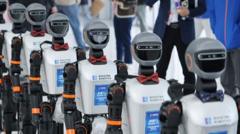
On a sunny day in Hanover, Germany, excitement buzzes around the humanoid robot, G1, created by Unitree, showcased at the famous Hannover Messe industrial trade show. This 4'3" (130 cm) robot stands out for its affordability and remarkable agility, captivating crowds with viral dance performances and martial arts demonstrations. Pedro Zheng, Unitree's sales manager, notes that the G1 can be programmed for autonomous tasks, drawing curious attendees who want to engage and interact with the robot, a stark contrast to many other displays around the venue.The potential market for humanoid robots is vast; they promise businesses a workforce that never tires or asks for raises, yet these creations face significant hurdles. Unlike robotic arms operating in controlled environments, the unpredictable conditions of homes or restaurants pose substantial risks. Current robotic technology, while making strides, still struggles to master the complexities of AI necessary to navigate real-world scenarios. A Unitree spokesperson confirmed that advancements in artificial intelligence represent a primary roadblock, indicating that contemporary robots still grapple with basic logical reasoning, which is essential for executing intricate tasks.The G1 is primarily aimed at research institutions and tech companies, allowing them to utilize Unitree's open-source software for innovation. Meanwhile, entrepreneurs are focusing on humanoid robots for industrial spaces. High-profile developments include Tesla's Optimus robot, with plans to manufacture thousands, and initiatives from other automakers like BMW and Hyundai, which have introduced humanoid robots into their production lines.As the landscape of humanoid robotics expands, Thomas Andersson of STIQ research tracks an impressive 49 companies dedicated to this field. With more than 100 firms identified when including wheeled robots with two arms, predictions lean towards Chinese manufacturers outpacing their global counterparts due to an established supply chain and robust investment environment. STIQ reports that nearly 60% of global funding for humanoid robotics is infused into Asian companies, further reinforced by substantial support from the Chinese government for robotics initiatives.In contrast, US and European firms struggle with logistics and costs. Bren Pierce, a UK-based robotics entrepreneur, highlights the challenge of sourcing components primarily from China, prompting many companies to manufacture their robots overseas. Pierce's latest creation, the KR1, illustrates this trend—designed for simple applications in warehouses, it avoids the complexity associated with full humanoid forms. Instead, by using commercially available parts, he reduces development costs while emphasizing ease of use for operators without extensive technical training.Despite the steady progress, experts like Pierce suggest that truly adaptable home robots remain at least a decade away. Reflecting on his journey in robotics, he still envisions a future where a versatile "everything robot" becomes a household staple but acknowledges the challenges that persist in achieving that goal. The competition in humanoid robotics is fierce, with both sides of the globe striving for innovation while pushing the boundaries of technology and usability.