In brief
Scientists have successfully used X-ray imaging and AI to 'unwrap' a 2,000-year-old scroll from Herculaneum, bringing its contents to light for the first time since the catastrophic eruption of Mount Vesuvius.
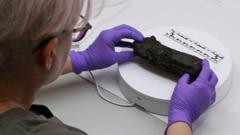
In a groundbreaking revelation, researchers have digitally "unwrapped" a charred scroll, dating back to the Roman town of Herculaneum, which was devastated by the eruption of Mount Vesuvius in 79 AD. This scroll, resembling a piece of burnt charcoal, has remained unopened for two millennia due to its extreme fragility. However, through the innovative use of X-ray imaging combined with artificial intelligence technologies, scientists have uncovered rows and columns of text latent within the scroll.Stephen Parsons, the project lead for the Vesuvius Challenge—a collaborative international initiative aimed at deciphering the Herculaneum scrolls—expressed optimism about the project's potential: "We're confident we will be able to read pretty much the whole scroll in its entirety, and it's the first time we've really been able to say that with high confidence." Initial scans have already unveiled some visible letters, suggesting that the scroll conveys philosophical content.The dusty legacy of Herculaneum includes hundreds of carbonized scrolls that were buried under meters of volcanic ash, much like the nearby town of Pompeii. In previous attempts to extract information, some scrolls were physically opened only to disintegrate into unrecognizable fragments, making this preservation effort critically important.The Bodleian Library at the University of Oxford, which houses many of these historical scrolls—once deemed unreadable—has cautiously stored them for decades. Nicole Gilroy, the head of book conservation, noted that only recently did the necessary confidence in these advanced technologies materialize, prompting the retrieval of one of the precious scrolls.To uncover the secrets within, the scroll was taken to the Diamond Light Source in Oxfordshire, where researchers employed a synchrotron—an apparatus that accelerates electrons to near-light speeds to generate powerful X-ray beams capable of analyzing the scroll without inflicting damage. The intricate X-ray scans work to see “things on the scale of a few thousandths of a millimeter,” as explained by Adrian Mancuso, director of physical sciences at Diamond. The process includes creating a 3D structure of the scroll and methodically identifying the various papyrus layers for a virtual 'unrolling.' Further complications arise from the challenge of differentiating ink from the carbon-based papyrus, leading the AI to search for subtle signals that might indicate the presence of ink before projecting the text onto the digital canvas.Parsons indicated that as efforts continue, the team anticipates moving from mere hints of text to substantial excerpts, building on previous successes that saw them decode about 5% of another scroll last year. Much of this previously inaccessible content likely revolves around Greek Epicurean philosophy, a field that promotes gratification through everyday pleasures.For Gilroy, the project fosters a significant connection with the ancient authors and scholars whose thoughts were immortalized in these scrolls: “There’s a real human aspect to it that I just think is really precious,” she remarked.As the Vesuvius Challenge forges ahead, it beckons further ingenuity to unlock the past, transforming fragile remnants into a dialog with history. The endeavor not only illuminates ancient knowledge but also deepens the understanding of human experiences across millennia.