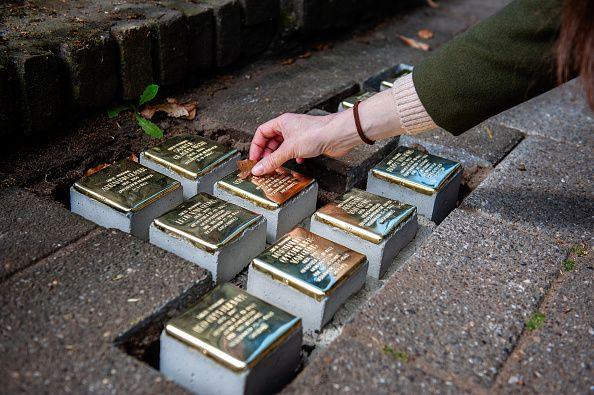
Just minutes ago, the council of Heidenau, a small town near Dresden in Saxony, voted to ban Stolpersteine – the bronze “stumbling stones” engraved with names of Holocaust victims that lie in sidewalks across Europe. AfD and CDU councillors justified the move by claiming that the plaques were “inappropriate for public spaces” and that memorials should instead be placed in the town’s cemetery, making it “impossible to step directly onto the memorial elements.”
The decision has drawn swift condemnation. Germany’s Education Minister Karin Prien, a member of the CDU, called the ban a scandal in a statement to Bild newspaper. She urged that banning such memorials prioritises death over life and renders Jewish people invisible in public memory.
Holocaust survivor and president of the Jewish community in Munich, Charlotte Knobloch, rejected the ruling as a “transparent manoeuvre by the extremists of the AfD.” She added that separating remembrance into a cemetery strips the streets of the lived history the Stolpersteine were meant to reveal. Knobloch noted that Munich does not host municipal Stolpersteine, preferring plaques on public buildings instead.
Local artist Gunter Demnig, who began the Stolpersteine project, warned that the AfD’s recent electoral gains – including major victories in Saxony‑Anhalt and Mecklenburg‑Vorpommern – make such a reversal almost inevitable. The party’s anti‑immigration stance and “Germany first” branding have resonated in the former East German states, where many see the remembrance of Nazi graves as a threat to their cultural identity.
Citizens of Heidenau have been divided. Some say the presence of the stones brings a painful reminder to the town’s frontiers, while others argue that they serve as an essential part of public memory, keeping history alive on the streets where the victims once lived and worked.
The national debate continues as the country wrestles with how best to honour victims of the Nazi era while confronting politics that threaten to hide or rewrite that history.