In brief
Fatima Bio's remarkable journey from almost becoming a child bride to her current role as Sierra Leone's first lady showcases her commitment to women's rights and empowerment. After fleeing a forced marriage during her youth, she became an influential political figure, championing significant laws against child marriages and advocating for educational equality for girls. Though facing public scrutiny and controversy, she remains a pivotal voice for social change in Sierra Leone.
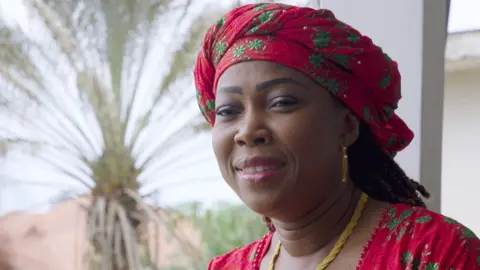
It takes Fatima Bio only a moment to respond when we ask what it was like to be an asylum seeker in London. 'Better than being married to an old pervert,' she says deadpan, before laughing - a reference to her father's plans to marry her off as a teenager. A lot has changed since then. In the years that followed, she became an actress, then met a man in London when she was interviewing him about influential Sierra Leoneans in the diaspora and married him. He was Julius Bio - and he is now Sierra Leone's president.As the country's first lady, Fatima Bio is seen as a compelling yet divisive figure - some young people see her as a refreshing voice in politics, who speaks up for women and girls, while others say she has overstepped her remit and that she is too vocal and too involved in the running of her husband's party.She has been booed and jeered at by MPs and criticized over a video that she shared on her social media channels featuring a notorious drugs dealer, whom she denies knowing. She quickly stops laughing and composes herself to tell us the story that inspired her to champion a law banning child marriage in Sierra Leone, which came into effect in 2024. She was almost a child bride herself. By the time she turned 13, her father, a diamond miner from Kano district, had arranged her marriage to a man in his 30s, whom she had known as an uncle figure since she was a little girl. 'There was no discussion. It was decided,' she says. But just before the wedding, when she turned 16 in 1996, Sierra Leone's civil war caused enough distraction to allow her to escape with the help of relatives and seek asylum in the UK.Fatima Bio landed in London on Christmas Eve, wearing a T-shirt, shocked by the cold, but relieved to have the opportunity of a new life. 'England was my amazing grace. I went to England, I got my voice,' she adds. 'I got my independence, and then I was able to fight for myself. And now I can fight for as many young people as possible.'Something else she gained in the UK was a council flat in Southwark, a home she still keeps today where her children live. As a form of social housing, council homes are usually cheaper to rent than private accommodation.Here at the farm, the first lady seems far more at ease than at the formal functions we had previously followed her to. Wearing jeans and an Arsenal football shirt, she takes us for a walk to see her many animals, including chickens, cattle, and goats. It is this accessible, aspirational image - a fresh face for Sierra Leone, where international narratives have long centered on child soldiers and blood diamonds - that has won her millions of likes on social media.She addresses taboo topics such as period poverty. 'Girls were missing at least 80 days of school a year because of menstruation,' says Bio. 'If you miss 80 days of the school year, it is almost like missing an entire term.' Her campaigning has helped bring awareness to issues that often go unspoken in her country.With more than 18,000 people on the borough's waiting list for housing, critics have questioned her decision to maintain a council tenancy while serving as First Lady. Yet, Fatima defends her choice, saying, 'My children are all British citizens. I'm paying for my council house myself. I have not committed any crime.'Despite her popularity among some, she has faced her share of backlash, particularly over a video featuring a drug dealer which she denies knowing. 'I wouldn't know because I'm not a criminal,' she states, cascading her confidence as she tells her story. As Fatima continues to play a significant role in Sierra Leone's socio-political landscape, she expresses her aspirations for the future, hinting at a desire for deeper involvement in government.Fatima Bio demonstrates resilience and a commitment to change, championing women's rights and governance reform in Sierra Leone. Whether she pursues the presidency herself in the future remains uncertain, but her journey continues to inspire and provoke conversation on the pressing issues facing women and girls in her nation.