In brief
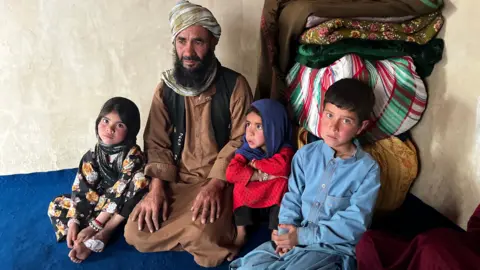
In Afghanistan, a staggering 75% of the population struggles to meet basic needs, pushing fathers like Abdul Rashid Azimi and Juma Khan to consider selling their children to feed the rest. With unemployment soaring and aid dwindling, fathers express their despair as they wrestle with the unimaginable choice between their children's wellbeing and their immediate survival. Reports indicate that nearly 4.7 million people are one step away from famine, prompting these heartbreaking decisions.
As dawn breaks, hundreds of men gather at a dusty square in Chaghcharan, the capital of Ghor province in Afghanistan. They line the roadside with weary faces, hoping for any work that will determine whether their families eat that day. The likelihood of success, however, is low.
Juma Khan, 45, has found just three days of work in the past six weeks that paid between 150 to 200 Afghani ($2.35-$3.13; £1.76-£2.34) per day. 'My children went to bed hungry three nights in a row. My wife was crying, so were my children. So I begged a neighbour for some money to buy flour,' he says. 'I live in fear that my children will die of hunger.'
His story is not unique. According to the United Nations, a staggering three in four Afghans cannot meet their basic needs. Unemployment is rampant, healthcare struggles, and the aid that once supported millions has dwindled to a fraction.
Ghor province is one of the worst affected areas, with record levels of hunger impacting more than a tenth of the populace; an estimated 4.7 million people are one step away from famine. The desperation is palpable as men like Rabani voice their distress: 'I got a call saying my children hadn't eaten for two days.' He adds, choking up, 'I felt like I should kill myself. But then I thought how will that help my family?'
This escalating crisis has pushed many to consider desperate measures. Abdul Rashid Azimi reveals, 'I'm willing to sell my daughters. I'm poor, in debt, and helpless.' He explains that selling one daughter could help sustain his other children for years.
Culturally, sons are viewed as future breadwinners, while daughters are often placed in dangerous situations due to various economic pressures. The incidence of underage marriage remains alarmingly common, exacerbated by limited opportunities for girls to receive education and employment under the Taliban's current regime.
Families like Saeed Ahmad's, who sold his five-year-old daughter for medical treatment after she developed appendicitis, exemplify this tragic reality. 'If I had money, I would never have taken this decision,' he laments, revealing the harsh reality of his choice for survival.
As the humanitarian crisis deepens, the international community faces pressure to respond effectively. The Taliban's government attributes the crisis to past regime failures and foreign economic interference while continuing to hamper women’s progress. Without urgent assistance, many fear that the future will be lost for countless children in Afghanistan.
Nurse Fatima Husseini, working in a local hospital, describes the profound impact of malnutrition on newborns. 'In the beginning, I found it very hard when I saw children dying. But now it has almost become normal for us,' she confesses. The heartbreak reverberates through communities as families must navigate the impossible choices of survival in a crumbling society.