In brief
Despite a ceasefire established six months ago, Gaza struggles with severe shortages as prices double, driven by disrupted supplies linked to regional tensions with Iran. Amidst a challenging humanitarian situation, Palestinians express frustration over neglect and the uncertain future of peace initiatives, including President Trump's peace plan.
Nearly six months after a fragile ceasefire came into force in Gaza, Palestinians in this war-torn territory are still struggling.
In the markets, there are again shortages of some goods and rising prices – with merchants saying supplies brought in from Israel have been disrupted by the new war in the region.
What does the war between Iran and Israel have to do with us? Prices have doubled here. Goods aren't coming in like before, says a shopper, Hassan Faqawi, despairingly. In this situation, the whole world is focused on Iran, America and Israel, and Gaza is forgotten.
While world attention has turned to the Iran war, there is increasing uncertainty about what happens in Gaza at a crucial stage in President Trump's 20-point peace plan, which halted the fighting in October last year.
In the past week at the UN Security Council, the High Representative for Gaza on the US-led Board of Peace, Nickolay Mladenov, laid out a detailed plan for Palestinian armed groups to decommission their weapons - linking compliance to the start of reconstruction.
However, a Palestinian official familiar with Hamas affairs suggested that Hamas would likely reject the proposals, raising the prospect of renewed military action as Israeli Prime Minister demands disarmament from Hamas either the easy way or the hard way.
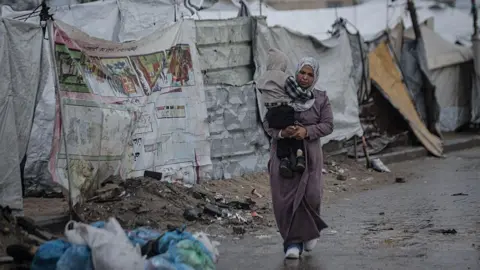
Heavy rain in recent weeks caused sewage systems to overflow in crowded tent camps. Although the Trump plan pledged immediate resumption of full aid for reconstruction - focusing on essential infrastructure - humanitarian agencies indicate that much more is required. Reconstruction materials essential for rebuilding efforts are still not being allowed into Gaza due to fears of their misuse.
In a statement to the BBC, Cogat, the Israeli agency managing the crossings, denied any aid shortages, blaming Hamas for exploiting resources.
Despite the ceasefire, Israeli airstrikes have persisted, with reports of civilian casualties including children. Meanwhile, Hamas appears to be consolidating its power, imposing heavy taxes on goods, further burdening Gazans already suffering from war's impacts.
Many Gazans, like the displaced woman Hanaa, express their fears for a controlled peace, echoing a desperate hope for stability in the region. The outlook remains uncertain as international focus drifts and the humanitarian crisis deepens.
At the UN, Palestinian envoy Riyad Mansour continues to support Trump's peace plan, maintaining hope in the peace process led by Mladenov, though skepticism about its viability in light of current tensions is widespread among the Palestinian population.