In brief
The new Bollywood film 'Dhurandhar' is making waves in India and Pakistan for its provocative portrayal of the ongoing hostilities between the two nations. Starring Ranveer Singh as an Indian spy, the film has sparked discussions about its nationalist themes and historical accuracy. Critics have raised concerns over its violent depictions and political messaging, even as it gains popularity at the box office. As the debate continues, both supporters and detractors weigh in on the film's impact on perceptions of national identity and the complex India-Pakistan narrative.
A new Bollywood spy film is generating praise - and unease - in India and Pakistan for its contentious portrayal of the longstanding hostilities between the South Asian neighbours.
Dhurandhar, which hit cinemas last week, plunges audiences into a high-octane world of espionage, gang wars, and patriotic fervour.
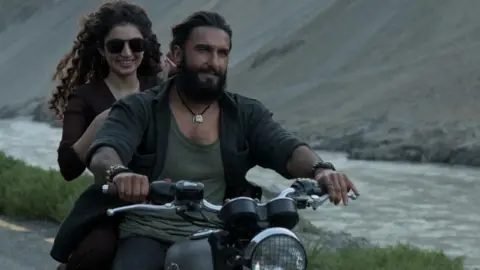
Anchored by Bollywood star Ranveer Singh's swaggering performance as Hamza, an Indian spy on a perilous mission in Karachi, the film traces his battles against criminal networks, shadowy operatives, and personal demons - all framed against the backdrop of India-Pakistan tensions.
While the action-packed sequences and riveting plot have earned praise from many viewers, the film, directed by Aditya Dhar, has also provoked sharp debate over its political messaging and treatment of historical events.
Dhar first gained national attention in 2019 with his debut Uri: The Surgical Strike, a dramatisation of India's 2016 airstrikes on Pakistan. The film was a major box-office hit and earned him a national film award.
Though Dhurandhar is only his second directorial effort, he has co-written and produced other films, including last year's Article 370 - which was a major success and earned praise from Prime Minister Narendra Modi.
Dhurandhar, arriving months after the worst India-Pakistan military clash in two decades, sees Dhar return to the political-thriller genre on a grander scale.
Deadly fights erupt in cramped rooms, gunfire rattles through crowded alleys, leaving behind trails of bodies, and torture scenes linger uncomfortably long. The violence is graphic and filmed in tight, suffocating frames that heighten the sense of discomfort.
Online, praise and criticism have flown in equal measure - some are impressed by the film's cinematic ambition and exhilarating plot, others find its hyper-nationalist tone and use of violence unsettling and inflammatory.
The debate has grown so heated that some reviewers faced backlash, with Dhurandhar supporters accusing them of judging the film through political bias rather than cinematic merit.
Despite the polarised reactions, the film has been drawing large audiences and has already become one of the year's biggest hits.
The trend is not surprising. In recent years, Indian cinema has seen a surge in nationalist blockbusters that openly reference government policies and historical events.
Spy thrillers have also long featured prominently, often portraying Pakistan as the biggest threat to India - a familiar trope rooted in decades of geopolitical tension between the two countries.
The makers of these films argue that they resonate with audiences because they address historical events and contemporary issues often overlooked by mainstream commercial cinema, sensitive, polarising subjects that touch on communal identity, national memory, and contemporary politics.
Even before it was released, the film faced legal scrutiny after the family of a late army officer alleged that parts of the plot were based on his life without seeking permission. Dhar denied this and the film was eventually cleared by India's Central Board of Film Certification as a work of fiction.
Yet, the film openly weaves several real-life events and historical flashpoints into the story, including news footage and real audio recordings of the attack on the Indian parliament in 2001 and the 26/11 Mumbai terror attack.
In fact, the story starts with a reference to the 1999 hijacking of an Indian passenger plane.
Critics have pointed out factual inaccuracies in the portrayal of the Karachi Lyari gang, normally involved in extortion, kidnappings, and drug-trafficking, being cast into cross-border tensions with India.
The sharpest criticism came from the Pakistan Peoples Party (PPP) regarding a scene featuring a fictional PPP rally, claiming it sought to portray the party as sympathetic to militants.
Despite its inaccuracies, commentators say the film, like many before it, is unlikely to dent Bollywood's popularity in Pakistan, which lacks a comparable local film industry.
The sentiment is somewhat echoed in India as well, where many viewers reject the political debates surrounding the film, choosing to watch it purely for entertainment.
As the bifurcated reception continues, both nations engage in a complex dialogue that highlights long-standing tensions and cultural perceptions through the lens of popular cinema.