In brief
At least 31 civilians and 17 security personnel have been killed in a wave of attacks across Balochistan province, where the Balochistan Liberation Army (BLA) claimed responsibility. An ensuing 40-hour gun battle resulted in the deaths of at least 145 attackers. The attacks have heightened security fears in a region already marked by decades of ethnic insurgency and alleged government oppression.
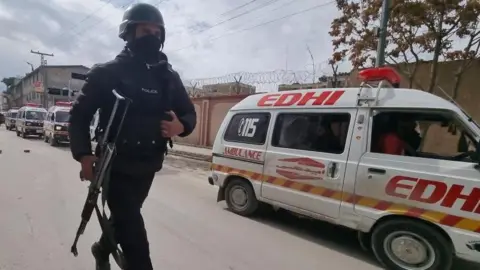
A series of gun and bomb attacks across Pakistan's south-western Balochistan province have led to the deaths of 31 civilians and 17 security personnel, as reported by the region's Chief Minister, Sarfraz Bugti.
In a swift response to the violence, security forces engaged in a 40-hour gun battle that reportedly resulted in the fatalities of at least 145 assailants. The Balochistan Liberation Army (BLA) has taken responsibility for the attacks, asserting that dozens of soldiers lost their lives in the assaults.
This surge in violence marks an alarming escalation within the impoverished yet resource-rich province, where the Pakistani government has confronted an ethnic insurgency for decades. Tensions have been further exacerbated by accusations from Pakistan towards India, claiming it supports the BLA—a charge that Delhi has repeatedly denied.
Attacks in the provincial capital Quetta and other locales targeted key sites including hospitals, schools, banks, and markets. Junior Interior Minister Talal Chaudhry indicated that attackers impersonated civilians and indiscriminately targeted people in public places while using civilians as human shields to evade retaliation.
Following the attacks, access to some key administrative buildings in Quetta was restricted, and mobile communication services were interrupted, causing further disruptions in the region. Prime Minister Shehbaz Sharif commended the military for its efforts and reinforced a pledge to combat terrorism aggressively.
The BLA claimed it had initiated a coordinated operation dubbed “Herof” or “black storm,” indicating a broader campaign against governmental authorities. They alleged that 84 security personnel were killed and 18 others abducted; these claims have yet to be independently verified, and the military has not provided any comment.
Local activists also allege that the federal government is exploiting the province's rich mineral resources without providing substantial benefits to the local population. Long-standing grievances against enforced disappearances are present, with the central government firmly denying such practices.
Balochistan consists of nearly 44% of Pakistan's total land area and shares porous borders with Iran and Afghanistan, harboring about 5% of the nation's population. Its vast resources, including gas and minerals, remain a point of contention, further fueling unrest in a region historically marginalized by national authorities.