In brief
The Singapore Airshow highlights a growing trend in luxury travel, with private jet manufacturers witnessing a surge in demand from Asia's wealthy elite. Gulfstream's G700 and Dassault Aviation’s Falcon jets draw keen interest, symbolizing a shift in aviation toward catering to ultra-high-net-worth individuals. While commercial airlines face strict profit margins, private jet sales soar, fueled by a 70% global rise in ultra-wealthy individuals since 2020.
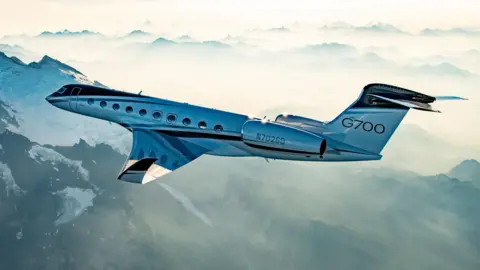
Clean lines, sweeping wings and wide oval windows: Gulfstream's G700 is among the most eye-catching aircraft at the Singapore Airshow, Asia's largest aviation and defence trade fair.Parked in a quieter corner of the tarmac, away from passenger jets and bulky military aircraft, it has drawn long queues of visitors waiting in the heat for a glimpse inside - a sign of the enduring interest in one of the world's leading private jet manufacturers.The lines move slowly. Sales conversations are still taking place on board, as customers consider aircraft that can cost tens of millions of dollars.Step inside and the appeal is immediate. Light streams in through almost panoramic windows onto pale leather seats and polished wood veneer.Staff describe the cabin as having 'living areas': one with a sofa and TV console, while at the rear, a bedroom they call a 'grand suite with a shower.'This is more than a touch of luxury. It reflects a broader shift in aviation. As commercial airlines continue to chase large volumes of passengers, private jet makers are focusing on a much smaller but far richer group of customers.The numbers underline the trend. In 2025, global private jet flights reached roughly 3.7 million - up 5% from 2024 and around 35% higher than before the pandemic, according to aviation intelligence firm WingX.Between 2020 and 2025, the number of ultra-high-net-worth individuals globally - defined as those worth more than $30 million - has also grown by more than 70%.'We are seeing a big shift of business aircraft for larger corporations and high net worth individuals,' said Scott Neal, Gulfstream's head of worldwide sales. 'More companies are doing business globally, and they need to travel to more places around the globe, and the most efficient way to do that is on a business aircraft.'Gulfstream is not alone: rivals including Dassault, Bombardier, Embraer and Textron Aviation are all competing in the space.But not everyone is cheering the trend, with environmental concerns being among the criticisms levelled at the industry.Nonetheless, plane manufacturers have sensed the business opportunity. Airlines - especially those offering long routes and full services - operate on thin profit margins.Airlines usually make a small amount of money from their operations, often just 2% to 4% above what they spend, according to the International Air Transport Association (IATA).Private jets are sold in small numbers but at very high prices. Plane makers also make money from support, parts and maintenance programmes.France's Dassault Aviation, best known for its military jets, is pushing its Falcon aircraft, saying that the technology developed for its combat planes improves the performance and comfort in its business jets. Private jets may cost tens of millions of dollars, but Carlos Brana, head of civil aircraft at Dassault Aviation says they make sense for frequent travellers. Customers that fly often may spend less over time than they would on multiple first-class tickets. He says most buyers are not chasing extravagance as much as efficiency: 'I want to go from that point to that point as fast as I can and not lose time in stopovers or connections.'Manufacturers advertise that they have improved cabin air pressure, reduced noise and refined interiors to make long flights less tiring. Some jets keep the cabin pressure closer to what they would experience on the ground, which companies say leaves passengers feeling less worn out after long flights.Asia is an important part of the growth story, with international traffic in the Asia-Pacific region growing by 8% in 2025. Gulfstream notes rising demand in markets such as Vietnam, Singapore, and Indonesia, while Dassault highlights burgeoning interest in India and Thailand.However, private jet travel still represents a much smaller share of the global aviation fleet compared to the US market, which dominates at around 70%. As demand grows, manufacturers focus on meeting the needs of this affluent demographic whilst also facing scrutiny over environmental impacts.