In brief
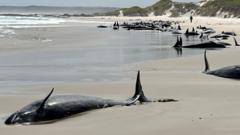
A severe mass stranding of false killer whales on Tasmania's north-west coast has led to the euthanasia decision for most of the 157 stranded animals, as challenging conditions hinder rescue attempts.
In an unfortunate event off the coast of Tasmania, more than 150 false killer whales have been declared either dead or set to be euthanised following a mass stranding on a secluded beach. The incident occurred near Arthur River, in the island's north-west region, prompting an urgent response from the Tasmania Department of Natural Resources and Environment.As of Wednesday, approximately 90 of the 157 stranded whales, many of which appear to be juveniles, were still alive. However, a team of wildlife experts assessed that the complex conditions at the site rendered any rescue attempts futile. Tasmania has recently experienced a series of similar mass strandings, the most notable being in 2020, but it has been over half a century since false killer whales have stranded in such numbers on the island.True to their name, false killer whales are one of the largest dolphin species in the world, capable of growing up to 6 meters (19 feet) and weighing around 1.5 tonnes. Despite their size, these creatures were found stranded at a location that is challenging to access, approximately 300 kilometers from Launceston. Local resident Jocelyn Flint shared her emotional encounter with the trapped whales, describing the distress expressed in their open eyes as they looked to her for help.The access difficulties have compounded the situation, as marine biologist Kris Carlyon explained that the terrain includes steep and rough single-lane roads, limiting the equipment that can reach the area. Experts initially attempted to relocate and refloat two of the whales, but faced obstacles as the animals were unable to navigate past the breaking waves and continually returned to the beach.With persistent harsh conditions predicted, the expert wildlife veterinarians made the difficult decision to euthanise the remaining survivors, citing the suffering caused by prolonged stranding. Dr. Carlyon noted that such action is always regarded as a last resort, and was deemed necessary for the well-being of the animals.The grim task of euthanising the whales is expected to begin on Wednesday and continue into Thursday, with authorities also facing challenges regarding the disposal of the carcasses in an area of significant cultural heritage for Aboriginal people. In light of the surrounding bushfires and limited road access, the public has been discouraged from visiting the stranding site.Tasmania accounts for over 80% of Australia's whale strandings, with a notable history of mass strandings involving pilot whales. Experts are still researching the reasons behind these events, with theories ranging from disorientation while hunting to one individual's error leading the group ashore.